Thursday, July 19, 2018

Breaking Glass Panelist: Paige Hernandez

Paige Hernandez will participate in the Breaking Glass forum at McCaw Hall on July 28. 

By Samantha Newland 


Seattle Opera continues its conversations on race and equity through Breaking Glass: Hyperlinking Opera & Issues on July 28 at McCaw Hall. The free forum, part of a larger national tour, is curated and produced by the Glimmerglass Festival in Cooperstown, New York. Following the meaningful community conversations surrounding Seattle Opera’s Madame Butterfly in summer 2017, and right before Porgy and Bess in 2018, Seattleites can get a view of race and equity in opera on a broader scale outside of the Pacific Northwest. Breaking Glass opens the door to a frank conversation about how art is produced in an increasingly diversified America, who has the right to tell whose story, and what roles social justice plays within the artistic mission of an opera company. The panel includes Tazewell Thompson, librettist of the opera Blue about a Black family whose son is shot by the police, Naomi André (author of Black Opera: History, Power, Engagement), Grammy-winning maestro John DeMain of Porgy and Bess, and finally, Paige Hernandez, creator of Stomping Grounds (2017) which blends hip-hop and opera. 

A multidisciplinary artist and educator, Hernandez has taught throughout the country to all ages and disciplines, to date, reaching approximately 10,000 students in over 100 residencies, workshops, and performances. As a performer, choreographer, and hip-hop advocate, her work has been seen at The Kennedy Center, Wolf Trap, Imagination Stage, Lincoln Center, among other stages across the globe. Hernandez tours internationally with her company B-FLY ENTERTAINMENT, promoting original works such as Liner Notes, Havana Hop and Paige in Full: A B-girl’s Visual Mixtape. She was named a “classroom hero” by the Huffington Post for her outstanding arts integration and work with STEM initiatives. Full bio here.


First of all, I just wanted to say I’m excited to hear you speak at the Breaking Glass series next weekend! Can you talk to me about your involvement with the event and why you’re participating in these conversations?
Breaking Glass is a national forum that the Glimmerglass Festival has incited as a way to keep the dialogue going surrounding opera and social issues. I fit into the fold because I was commissioned to write a “hip-hopera” (Stomping Grounds) for the Glimmerglass Festival. I tried my best to explore topics of race, identity, immigration, displacement, and issues dealing with home. Being able to talk about my process as a librettist and as a Woman of Color artist is just insightful. It’s nice to be able to talk about my experience in the opera world. In the Breaking Glass forums, we compare my experience to Tazewell Thompson’s. (Thompson is currently working on the story of a Black family, Blue) that premieres next summer. In the forum, we talk about how our two projects have the same intentions but different processes.


Tell me more about how hip-hop and opera intersect in your work Stomping Grounds.
Stomping Grounds essentially looks at the concept of home; looking to, coming from, and moving away from, home. I told the story through those perspectives, through immigrants, refugees, and people who have been displaced. Then I put it into a big metaphor for how these different perspectives could intersect. For me, this was through a coffee shop that’s facing gentrification. Sadly, gentrification is wildly popular in urban coastal areas like D.C., where I’m based. 


Stomping Grounds tells the story of a neighborhood coffee shop facing turmoil in the form of gentrification. 
In this story, the coffee-shop owner is a Cuban woman, and her love for grounds is all around: for her, I mean coffee grounds. She also reads her fortune in her coffee groundsand also for the grounds she has come to love, the ground that she stands on. We learn that she is fighting a developer, an African American gentleman. We go through the ups and the downs of the story, only to find out eventually that the answer to her problem, to her being displaced, comes from her digging into her own ground, in the yard at the coffee shop, where she finds relics from the Underground Railroadthings like slave shackles and fishing basketsand because she has found these things, her coffee shop is now a historical site; it can’t be torn down or be developed. It’s all linkage. She is upset with this African American man and he is upset with her, but we’re all connected. We’re all connected through the ground.

I wanted to tell that story with two genres of music that I thought could really help to illuminate the issues at hand. Hip-hop naturally brings a fresh youthfulness and opera brings a very dramatic storytelling element. It was great to be able to write something that could lean on both of these genres equally, that was important to me. When you experience the piece, it truly is 50/50 hip-hop and opera. I wanted to make sure that each art form could shine.

What do you think opera can gain from hip-hop?
In my process, hip-hop helped the performers to be more well-rounded. We were doing classical music, but we were also looking intentionally at rhythms and music, and the African diaspora specifically. I saw how much hip-hop and opera played off of each other, played in tandem, but more than anything, how this mashup cultivated a new, young audience. We were able to tour Stomping Grounds to several different schools throughout New York City, as well as New York state. We visited middle schools, high schools, colleges and they were eating it up. It was just really nice to be able to say this was their first exposure to opera; it created a bridge to get their appetite going for more opera in their lives.

Hernandez with the cast and crew of Liner Notes, a "live musical journey through hip-hop's many intersections." She wrote, produced, directed and performed in the production. 
In your view, how do people tend to perceive opera? How do events like Breaking Glass impact this reputation?
Unfortunately, everything I had assumed about opera is still pretty much correct. From my first experience with opera in 2017, it felt very elite and exclusive. I wasn’t sure if my voice would be heard or if my expertise, which is hip-hop, would be championed. I definitely got a lot of questions, side-eye, and push-back about my artistic genre, which is too bad. But, my experience creating an opera also showed me that this is an art form steeped in tradition and history. Some purists want to keep it that way. Some people are excited about engaging with the art in pathways toward progress or inclusivity. I think that is something the Breaking Glass forum, as well as the podcast, are attempting to crack at, to break that glass and say, “We’re out here! We’re well aware of the challenges. We want to make everyone else aware so that we can start to move forward together.” Opera is a genre that can still catapult social change.
Hernandez used her background in hip-hop to tell the story of her personal path to self discovery in Paige in Full.

What was your first experience with Porgy and Bess? (We perform it shortly after Breaking Glass).  
Well, it’s interesting because my husband is a jazz musician (upright bassist). And I think my first live experience with Porgy and Bess was watching him perform “Summertime” with a jazz vocalist.
After that, I saw it on Broadway with Audra McDonald and Norm Lewis. Then, Glimmerglass produced it last summer (the same production Seattle Opera is about to present). It’s was almost was like Stomping Grounds and Porgy and Bess were in tandem. We actually encouraged that; people could leave Catfish Row, and then come on down to modern America, USA in my piece.
Audra McDonald and Norm Lewis in the 2012 Broadway revival of Porgy and Bess
How does Porgy make you feel today? 
I have a lot of complicated feelings about that piece. For representation reasons, I think it’s great. I understand that it’s the only access and entrypoint for a lot of artists. For those reasons, I support it. But the story feels dated to me, some of the language and text, as well as the archetypes and stereotypes; I find to be a bit problematic.
When I see the show, I very much appreciate the art at hand, which is the singing, the staging, the directing and the lightsthose are things I tend to focus on. I focus less on it being a story about People of Color written by white people. To me, it just reads as unauthentic. It’s a tough pill to swallow for me.


Is it possible to love something while understanding its limitations?
I’m noticing that I am changing. Because of this current societal and political climate, I have less of a tolerance for it. I think 10 years ago, I would have been fine with it being produced forever and ever and seeing it multiple times. Now, I feel like enough already. There’s just so much of that already there. I’m just interested in new ways to tell that story.


I see that you have been very active in youth education and arts programming. Tell me about this passion.
Absolutely. I am a big advocate of arts education, using the arts to teach curriculum and life skills, and to help in a young person’s social and emotional development. The arts not only saved my life; they gave me a life. I had teaching artists all around me growing up. I had the opportunity to go to a performing arts high school where the teachers were invested in that way. It’s a mission of mine to make sure that education is always present in the work that I do. I always want to be engaging with youth and with the community.
Hernandez performing Havana Hop, which was showcased at the International Performing Arts for Youth in Montreal, Canada. 
One thing I noticed growing up was, with the arts I was exposed to, things felt dumbed down. It was as if they thought we weren’t ready to discuss certain things or that we weren’t mature enough. So I like to give youth something sophisticated to gnaw on instead. I like to provide awareness. I’m not being preachy. I’m not trying to convert or give opinions. I’m just trying to give them all the information they need to make choices and form their own opinions.

We often hear the term “representation matters.” What does representation in the arts world mean to you and your production company B-FLY?
Representation, to me, means just that everyone is represented. With my company, B-FLY Entertainment, I work really hard to make sure that our work is multicultural and multigenerational. It’s trying to tap into representation onstage that I just hadn’t seen before. Even with this opera, for casting, it was very difficult for the traditional casting process because I wanted a woman who would represent my main character in a way that was grounded and also wasn’t some Disney cut-out ingenue. Instead, she was a woman with curves and flaws and problems, but also was nuanced, complicated, and intricate. It meant that she would be a mezzo and have a deeper voice, where my composer wanted a higher voice. These were some of the things I noticed right away. For me, at the end of the day, it was still about representation. I had never seen a full-bodied Latina in a lead role in opera, let alone in theater. So it was a mission. But not just that, it’s not just about gender, it’s also about race, even gender identity. All of those things are really important to me. I found that, more than in theater, which is my background, opera keeps casting in a box. I just wanted to break out of that. So, I picked performers who weren’t necessarily the cream-of-the crop in auditions, but I was able to pull out of them brilliant work during the process. In the future, I’d like to see the opera world be more willing to take risks to make representation a priority.


Breaking Glass: Hyperlinking Opera and Issues
Saturday, July 28 at 10:30 a.m.
Nesholm Lecture Hall at McCaw Hall
FREE Event!

For more info and to RSVP to Breaking Glass, click here

Please note: If you are planning on attending, there will be substantial road closures around Seattle for the Torchlight Parade.


Wednesday, June 6, 2018

LGBTQ youth respond to O+E

Seattle Opera's O+E offers an important moment of queer and women representation. The performance features two women in a same-sex marriage, and was created by an all-women creative team and cast of principal singers. 
Representation in art matters. When you’re a young person, being able to see a performer onstage with your same skin color or gender identity for example, can be the difference between feeling like part of society, and feeling unwanted by it. In honor of Seattle Opera’s O+E, which tells the story of Orpheus and Eurydice with two women in a same-sex marriage, Seattle Opera invited two LGBTQ youthboth singers in our Teen Vocal Studioto share what it’s like to see themselves represented in opera for the first time.

Naomi O’Neil, 17 
Skyline High School / Bellevue College 
She/her/hers 
A choir singer since fourth grade, Naomi participated in a camp with Seattle Opera’s Programs and Partnerships Department, before joining the Teen Vocal Studio program. The mezzo-soprano has enjoyed various aspects of her time training with Seattle Opera's youth programs; she performed in Robin Hood this past winter, and has recently taken several various masterclasses through the Teen Vocal Studio.


As a member of the LGBTQ community, how often have you felt represented in opera or classic stories? 
I’m a lesbian, and I pretty much never see myself represented. At least, not in opera. Most operas I’ve seen do not have much diversity. It’s a little disheartening, but things are getting better. I have seen more representation in TV, but I feel like gay characters often end up getting killed off. I used to love Supernatural, there was a lesbian character who I really liked, but I stopped watching when she was killed off. Sometimes it seems like Hollywood just adds gay people to their shows, just to have them (and get the viewership). However, these characters rarely get any significant or meaty story of their own.    

Naomi O'Neil 
What would you like to see more of in art and entertainment? 
I want to see more stories written by and created by gay people. If you’re going to tell a story about us, you need to have a gay person working on it so you don’t do something accidentally offensive.

What was the most powerful thing about O+E?
Honestly, it was like a breath of fresh air. It was powerful to see a story about gay people where the narrative wasn’t simply about them being gay or coming out.

Of course, the role of Orpheus is often sung by a woman in a pants role. You get used to seeing a girl playing a guy in opera. It was so refreshing to see a female character just being herself as a woman.

I also thought it was very beautiful—I loved the lighting and costumes (even though I kept hearing the Italian version in my head!).

Do you feel supported in living your truth?
Yes. Of course there are always going to be homophobic people, but I do feel free to be me. I don’t spend too much time at my high school because I do running start. Bellevue College has a wonderful LGBTQ Center, which is so nice because I can’t make it to my school’s GSA. I think also, the power of the Internet has helped LGBTQ youth; it’s given us a community even when we can’t physically be together.

Why is LGBTQ representation important onstage?
Because we grow up seeing straight characters in everything, and that’s what we think of as “normal.” We need to show gay youth that they are also normal.

Natalie Ositis, 16
Shorewood High School
She/her/hers 
A longtime lover of musical theater and all-things theatrical, Natalie has been involved with Seattle Opera for the past four years through various youth camps and performances, most recently, Teen Vocal Studio. Today, she shares this passion with both her father, a former music major in college, and her mom Kim, who works on Seattle Opera’s Development Team. A talented visual artist as well, Natalie looks forward to continuing to carve out her own niche in this world and combining her love of visual and performing arts as she grows up. 

As a member of the LGBTQ community, how often have you felt represented in opera or classic stories? 
I identify as pansexual—I don’t have a preference based on sex or how someone identifies gender-wise. For me, it’s more about how I connect with that person. Also, I’m pretty butch. Opera often lacks representation—you’re definitely not going to find many LGBT characters in older works, at least.

Natalie Ositis flanked by two cast members from Seattle Opera's Hansel and Gretel: Marcy Stonikas and Mark Walters.  


What was the most powerful thing about O+E in your view? 
The fact that O and E are in love, but this is portrayed as if being a gay couple is the most normal thing in the world—is powerful, and unfortunately, not something you see everyday. A lot of the time, when you see a gay couple in a story, their gayness is the whole point. In O+E, the focus is on a functioning, loving couple. That was very encouraging. Other moments that stuck out—it was so powerful when Eurydice comes out in a veil—you think it’s going to be a wedding dress, but she’s actually wearing pants. She was so beautiful and confident.

When Seattle Opera presented As One, some of our gay and trans community partners said that people your age are living their identities with a freedom they admire and wish that they’d had.

What do you think about that? Do you see young people getting to be themselves today?  
It really depends on where you are. For me—I’ve been immensely lucky. I live in an accepting community with really awesome parents and great, like-minded friends. Some of my friends live in more conservative environments—they have to find other ways to express themselves. In general, we are definitely living in a much more accepting time, though. We would not be here as an LGBTQ community without the passion and hard work of those who came before us. Their steps have formed the basis of why people like me can have a good life, and that’s something I’m really grateful for.

How was this opera different than other operas you’ve seen?
Seeing a performance in the round was cool, because there’s usually a degree of separation between the performers and the audience. Performed in the round, you get to be a lot more intimate with the performers. One thing I noticed with the Orpheus—the movement of her hands, the way she portrayed emotion waiting hunched over the chair. She turned her wedding ring over in her hand in anticipation—it made it feel more real.

Why do you think other young folks would like O+E?
Because it feels genuine. You can connect with the performers on an emotional, and even spiritual level. I think the modern setting makes it easier for young people to identify. The story line was an emotional roller coaster: brief comedic moments. Joy. Sadness. You can't help but get invested. It was an experience I'll never forget.

Magda Gartner (O) and Tess Altiveros (E) in Seattle Opera's O+E. Philip Newton photo
Seattle Opera's O+E runs through June 10. 
Tickets & info: seattleopera.org/oande

Friday, May 11, 2018

Praise for Aida

Alexandra LoBianco as Aida. Philip Newton photo
"A visual knock-out." - Oregon Arts Watch 

"Few productions have been as eye-catching and unforgettable as Zambello and RETNA’s." - Bachtrack 

"... with lots of action and bold design elements that constantly shift and move." - The Seattle Times

"What a gigantic, dramatic, sweeping show with powerhouse voices (of course)." - M.J. McDermott, Q13 Fox News

Milijana Nikolic (Amneris). Philip Newton photo
"Milijana Nikolic brings Amneris, the Egyptian princess also in love with Radamès, a regal mien (complete with tiara), casting sidelong glances like poison darts, swanning about, emoting grandly—and she’s magnificent." - Seattle Weekly 

"There’s a lot to see in Michael Yeargan’s ingenious, inventive set, and in the vibrant, red-and-gold hieroglyph/graffiti-influenced designs of the artist RETNA. They’re strikingly effective: these designs might be seen on today’s urban street scene, yet onstage they evoke ancient hieroglyphics." - The Seattle Times

"The secure vocal beauty of soprano Marcy Stonikas in the much smaller role of the High Priestess (was) gratifying."- Bachtrack 

Seattle Opera presents Verdi's Aida. Philip Newton photo
"In the role of Radamès, the ill-fated commander who loves Aida, Brian Jagde displayed superb power and focus, but also was able to dial down that Wagner-sized tenor a bit in his more tender scenes with Aida." - The Seattle Times

"From (Leah Crocetto's) first soaring phrase, the uncommon radiance and beauty of her highs won the audience over. Her acting, too, was deeply convincing. 'Ritorna vincitor! ... received the longest applause of the evening. Low notes had telling power, highs glowed, and every phrase was rounded with finesse." - Bachtrack 

Leah Crocetto makes her Seattle Opera debut as the title role in Aida. Philip Newton photo
"The chorus, prepared by John Keene and absolutely essential to the success of Aida sang with strength and accuracy." - The Seattle Times

"The discovery of the night was the Radamès, Brian Jagde, his voice bold, bright, and resonant, effortlessly hall-filling. A heroic Italian-style tenor to the marrow, he makes an ardent, boyish Radamès—and if he can deepen and darken his stage presence, he could be the Otello I’ve been waiting 24 seasons for Seattle Opera to find." - Seattle Weekly 

Members of the Seattle Opera Chorus in Aida. Philip Newton photo
"Despite the famous grandiosity of the opera, this show never feels static, largely because of Jessica Lang’s imaginative choreography." - The Seattle Times

"At times, the stops are fully pulled out when the stage holds nine dancers, a half-dozen well-choreographed young boys, the entire chorus, and handful of main characters ... No detail — or cost — seemed spared." - Oregon Arts Watch 

Dancers perform choreography by Jessica Lang in Aida. Philip Newton photo
"SO has double casts for main roles (which) are no longer segregated into 'gold' and 'silver'; both sets of singers are equally skilled with different kinds of complementariness. Main roles require big sings, and the opera’s 11-performance run is a marathon, so a dual cast is essential." - Oregon Arts Watch 

"Even the smaller roles shone: Eric Neuville’s lyrical Messenger, and the powerful Marcy Stonikas as the High Priestess." - The Seattle Times

"Superb lighting from Mark McCullough and Peter W. Mitchell ensured that every decorative element of Yeargan’s scenery would make its mark." - Bachtrack 


"Verdi’s music is superb, and was excellently played by the orchestra under John Fiore." - The SunBreak 

"... an imaginative balance between the show’s big-moment pageantry and the intimate smaller-scale scenes ... this production is never static, always evolving." - The Seattle Times


"The opening-night cast on Saturday presented American soprano Leah Crocetto in the title role. Her voice is beautiful, large and vibrant, and she is a passionate actress." - The Seattle Times


"John Keene’s chorus was superb, and E. Loren Meeker’s stage direction surprisingly effective." - Bachtrack 


"(Francesca Zambello and E. Loren Meeker) did not let the spectacle steamroll Aida’s human story ...  they got the balance of the opera’s grand moments and its intimate ones just right, so we care about the characters and their troubles." - Queen Anne News

"Bass-baritone Alfred Walker can always be counted upon for a stellar performance, and he nearly stole the show as Aida's father Amonasro." - Seattle Gay News 

"On Sunday, an alternate cast took over the principal roles. Alexandra LoBianco gave a subtle but impassioned performance in the title role; her Radamès, David Pomeroy, proved an excellent singing actor, and Alfred Walker made a compelling Amonasro." - The Seattle Times

"Verdi undoubtedly would have appreciated that I felt both uncomfortable with the opera’s aggressive, overwhelming nationalism and pain for Aida, Radamés and Amneris’ predicaments. And kudos to the cast, musicians and production team for taking me there — and, of course, for the magnificent music." - Queen Anne News

"I left the auditorium feeling very moved by the sorrowful, touching end of the faithful lovers, and the broken hearted princess whose love brought death on the very man she had hoped to marry... (The production) tells a great story, both on a personal and a political level, and it uses all the considerable resources of our wonderful Seattle Opera Company to its fullest." - Seattle Gay News 

"A major selling point, rightly, has been the artistic design by the street artist RETNA, whose graphics evoke both graffiti and, in a nod to the opera’s setting, hieroglyphics. It gives this repertory favorite a fresh, contemporary look ... Anita Yavich’s costumes for the women’s chorus are a heady riot of color, and the two together combust like fireworks." - Seattle Weekly 

"But this grandly, this opulently, this eloquently? Unless Verdi is on your hate list, you won’t be disappointed by this three-hour Aida, no matter how often you’ve heard it before." - Oregon Arts Watch 

Tuesday, May 8, 2018

Youth invited to collaborate with graffiti artist 179

Free event for young people age 11-18

179 is a Latina activist and artist. 
Teens and pre-teens—come create art in McCaw Hall with Seattle graffiti artist Angelina Villalobos on Saturday morning, May 19. No artistic experience is necessary to participate in this art-making experience, and participants will also have the opportunity to get a backstage tour on the Aida set, which includes artwork by the street and studio artist RETNA.

Seattle Opera is thrilled to be providing this free event in partnership with Villalobos a celebrated Northwest artist, as well as Urban Artworks, a Seattle nonprofit which empowers at-risk youth. 

At the May 19 event, Villalobos will guide participants in the creation of 7-by-8-foot art pieces. Youth who identify as People of Color or LGBTQIA+, as well as young people living with disabilities, are encouraged to sign up for the limited number of spots.

To sign up:
Contact Courtney Clark (courtney.clark@seattleopera.org) with the following information:
- Participant name
- Email address
- Desired time slot (see more below).

Session I: 
9:00am –11:00am (Collaborate with Villalobos)
11:15am -11:45pm (Backstage Tour of Aida set)

Session II:
10:00 am – 11:45 am (Collaborate with Villalobos)
11:45 am – 12:30 pm (Backstage Tour of Aida set)

Session III: 11:00am -11:45am (Backstage Tour of Aida set)
12:00pm - 2:00 pm (Collaborate with Villalobos)         
- You must also include a permission form/release signed by a parent/guardian.

The signed permission form/release can be returned via email (courtney.clark@seattleopera.org), fax (206-389-7651) or at the time of the event. Only students who provide a signed release/permission form can participate in the event.

Mural by Angelina Villalobos, 179. 
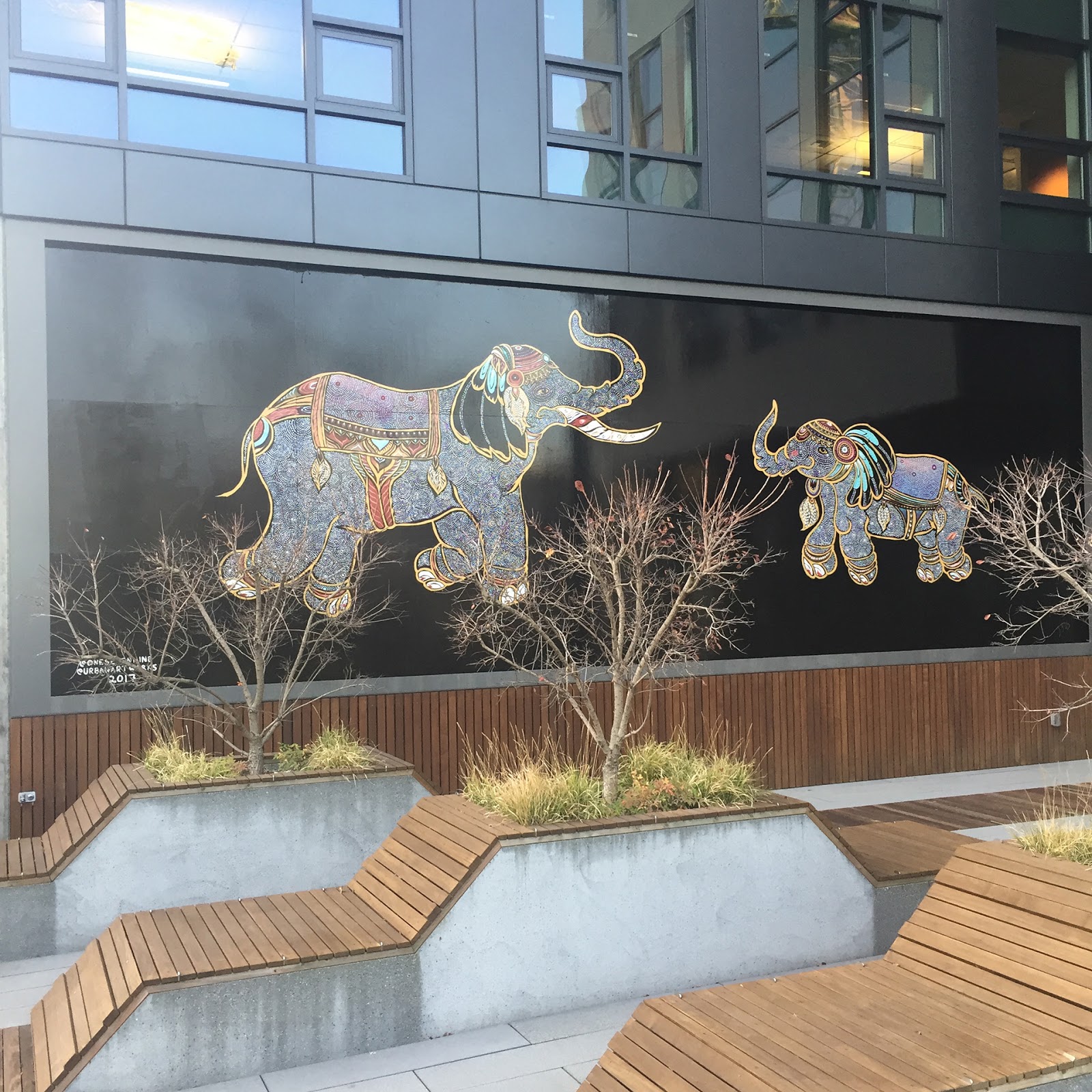
Seattleites may recognize Villalobos' colorful murals, located throughout the city (including the elephant mural next door to Seattle Opera's offices in South Lake Union!).

"I’m a Seattle-born art activist who's passionate about connecting art with action," Villalobos says. "My work strives to engage viewers to partake in their environment through observation and participation. I believe community engagement is vital to successful art-planning, and that art should be accessible to all."

Villalobos, who goes by the pseudonym 179, grew up within Americanized Mexican Catholic culture. Today, she often mixes the iconography of Catholicism with pop culture to folklore. This union, influenced by being raised in the Pacific Northwest in the the 90’s, is an intimate exemplification of her personal pursuit of understanding the world around her. Angelina creates a fairy-tale land filtered through the eyes of an anime and comic book lover.

.

.


Wednesday, April 25, 2018

RETNA youth event canceled

Updated May 3, 2018:

Seattle Opera deeply apologizes to the young people who had signed up for our May 1st event to work with RETNA (Marquis Duriel Lewis), an internationally-celebrated artist whose work is featured in our upcoming Aida. It was especially disappointing that RETNA chose to cancel the free event, because this would have been an important opportunity for young people, including People of Color, in Seattle to work with an accomplished graffiti artist (whose practice now includes street art and painting on canvas), and who identifies as Black, Salvadorian, and Native American. We had hoped that this event would have been a step forward in serving intersectional youth, and individuals who do not always feel implicitly welcome in our opera community. RETNA’s cancellation was a setback, but we promise that we will continue to create programming geared toward equity. We continue to plan easily-accessible events for the diverse people of our region.

- Seattle Opera


Born Marquis Duriel Lewis, the street and studio artist RETNA makes his Seattle Opera debut as Artistic Designer of Aida. In our upcoming production, RETNA uses the same illuminated script that's earned him commissions from Justin Bieber and Usher. 


Free event for young people age 11-18

Seattle Opera has a once-in-a-lifetime opportunity for Seattle-area youth ages 11-18 to collaborate and create with American street artist RETNA on Tuesday, May 1 at McCaw Hall. This event is Free! RETNA’s art will be featured in Seattle Opera’s upcoming production of Aida May 5-19. 

No artistic experience necessary. Youth who identify as People of Color or LGBTQIA+, as well as young people living with disabilities, are encouraged to sign up for the limited number of spots.


RETNA will guide students in the creation of 7-by-8-foot art pieces that will be on display at McCaw Hall. Known for his long and geometric script, RETNA will be creating outlines, and then the teen artists will fill in the negative space with their own creativity.


To sign up: 

Contact Courtney Clark (courtney.clark@seattleopera.org) by 5 p.m., Monday, April 30 with the following information:
- Participant name
- Email address
- Desired time slot (see more below).
  • Session One: 4:00 pm-6:00 pm - Space available  
  • Session Two: 5:00pm-7:00pm - Space available 
  • Session Three: 6:00pm-8:00pm - Session FULL 
  • Wrap-up Session: 8:00pm-8:30pm (All Participants/Everyone) 
- A permission form/release signed by a parent/guardian.

The signed permission form/release can be returned via email (courtney.clark@seattleopera.org), fax (206-389-7651) or at the time of the event. Only students who provide a signed release/permission form can participate in the event.


"Of our youth” Chato in Culver City collaboration by EL MAC and RETNA
About the Artist 
Born Marquis Duriel Lewis, RETNA picked his moniker from the lyrics of a Wu Tang song that resonated with him in his youth. While he got his start with graffiti and tagging, RETNA’s practice now includes street art and painting on canvas. RETNA, who identified as Black, Salvadorean, and Native American, developed his long, geometric script while looking toward Egyptian and Native American traditional symbols. Egyptian hieroglyphics are one of the marked influences on his unique alphabet. 

Street Art and Opera
The work of street artist RETNA comes together with the music of Giuseppe Verdi for Seattle Opera’s Aida. Verdi and RETNA are not as far apart as one may assume. Graffiti and opera can both be controversial. Both can promote social change or protest on behalf of those seeking freedom from the oppression of society, religion, and the state. Like RETNA and other contemporary street artists, Verdi was not afraid to take risks or fight entrenched power structures.

"Interestingly, RETNA has as much of an authentic connection to Egypt as Giuseppe Verdi did, if not a greater one: Egyptian hieroglyphics are one of the marked influences on his unique alphabet." [ Read more HERE ]. 


Seattle Opera's upcoming Aida. Photo by Cory Weaver 


Friday, March 30, 2018

AIDAN LANG INTRODUCES AIDA

Listen to or read this downloadable podcast by General Director Aidan Lang introducing Seattle Opera's upcoming production of Aida. Lang debunks some of the myths attached to Verdi’s masterpiece, explores the complicated genesis and nationality of the opera, and explains how Verdi’s musical representation of patriotism evolved over the course of his lifelong experience of Italian unification. Aida plays at Seattle Opera for nine performances, May 5-19.

Hello, everyone, it’s Aidan Lang here, this time of course I’m talking about our next production, which is Verdi’s Aida.

It is an immensely popular piece. Why is that? I think the scale is number one. The fact that it is a grand opera, in many ways the grandest of grand operas, is very attractive. It’s not often we get to see operas of that scale. That’s a key to the popularity.

Monday, March 12, 2018

Black inclusion at Seattle Opera


By Gabrielle Kazuko Nomura Gainor

This spring, Seattle Opera is excited to be working with Social Impact Consultant ChrisTiana ObeySumner as we continue our racial equity work. ChrisTiana will help Seattle Opera forge a dialogue with members of Seattle’s Black and PoC communities leading up to our Aida and Porgy and Bess productions. 

Ultimately, they (ChrisTiana uses they/theirs pronouns) will help Seattle Opera envision a future for opera that truly includes and honors people of color—a process that made meaningful strides this past summer with members of the Asian Pacific Islander community during Madame Butterfly.

ChrisTiana has a BS in Psychology, a Master in Nonprofit Leadership, and is currently pursuing a Master in Public Administration at Seattle University. Their area of expertise and research is the relationship between marginalized and oppressed intersectionalities and access to basic human needs and rights in American society. ChrisTiana is the General Co-Chair and Housing Committee Chair of the Seattle Commission of People with disAbilities. They are also the founding Executive Director of the Eleanor Elizabeth Institute for Black Empowerment. 


You have been coming to Seattle Opera for several years now. What was your introduction to the art form?

My introduction to the art form was watching a blue alien sing opera in The Fifth Element. I was 8 years old, and I felt like I could see myself in this character. Her hair reminded me of dreadlocks, and as a Caribbean Black and AfroLatinx, I identified with that. I identified with her blue skin even because it wasn’t white. I saw that you don’t have to be White to be a diva and sing this amazing aria.

A still from the movie, The Fifth Element. 

Envision a beautiful future for opera in Seattle. What do you see?

I would love for McCaw Hall to become a space where an 8-year-old girl of color can think, “I can be up there. That’s something I can do.” Operas like Porgy and Bess and Aida are important opportunities for representation that Seattle Opera should take advantage of.

I would like to see Seattle Opera make a more explicit invitation to PoC communities, and more implicitly make the opera a place where everyone feels welcome. Sometimes when people don’t see themselves in a space, they worry: “Am I going to be the only Black person there?” “Will people stare at me?” “Am I going to feel comfortable?” Or, for my friends who have disabilities—“Will there be a space for my wheelchair?” “Will I be able to make it back from intermission in time?” “Will there be strobe lights that will affect my epilepsy?” What I’ve been brought in to do—and , and what I’m honored to do—is to help identify and break down some of these barriers, both real and perceived.
Among other artists of color, Black tenor Vinson Cole (pictured with Sheri Greenawald) is celebrated as one of Seattle Opera's legendary performers. In its 55-year-history, Seattle Opera has made conscious efforts to hire Black singers through colorblind casting under the direction of Glynn Ross and Speight Jenkins. At the time, these were audacious and important stepping-stones for racial equity. Now in 2018, the conversation on racial equity has moved forward. In 2018, we see that classical European art forms such as opera and ballet are still overwhelmingly white, from the decision-makers at these organizations, to the artists and audience members. While colorblind casting was helpful in some ways for minority representation, it is no longer the way forward. In order for opera to speak to the people of Puget Sound, Seattle Opera will make conscious efforts to hire storytellers and artists who represent our region's diversity moving forward. As part of our racial-equity work, we have learned that we cannot be "blind" to color; we must recognize and acknowledge the lived histories of  marginalized people. This includes making amends with those we have hurt through practices such as blackface (also yellowface and brownface) and  cultural appropriation. Photo by Ron Scherl 
ChrisTiana attends Seattle Opera with friend, John. Philip Newton photo
What made you want to work with Seattle Opera?
I love opera. Opera, like all art, is a way to get a temperature, a pulse at the time—how people thought and understood other folks in terms of race, ability or gender. There is a beauty in being able to see where we came from, like “Oh wow, this is how they thought about women back then?” But it’s important to remember we’re in a new place now. Looking at opera with a twenty-first-century consciousness, we have a lot of updating to do. That updating could include owning some of opera’s problematic history, discussing it with a critical lens. It could include moving toward more color-conscious casting. It could include increasing diversity both onstage and behind the scenes. Maybe a director takes an opera like La bohème and places it in Harlem, for example. What we can’t do, however, is to move forward with this historic art form without any discussion or consideration for the world we live in today.

Of course, not all operas performed today are stories of the past. Seattle Opera's As One depicts a single, transgender woman protagonist, as told through two singers at Washington Hall. While singers Taylor Raven and Jorell Williams are cisgender, librettist Kimberly Reed, a trans woman, provided both words and inspiration for the story. Rozarii Lynch photo

Obviously, you cannot speak for all Black people. But what, in your own experience, is a barrier for Black folks coming to the opera?
Well, first of all, Jim Crow laws meant that Black performers and audience members would either be excluded altogether, or would often not be presented with the same opportunities. But, in terms of people today, from my experience, it’s the unspoken feeling of unwelcome. It can feel like people are saying, “Are you really supposed to be here?” There’s so much historic trauma and even contemporary trauma of feeling and being unwanted in these sorts of spaces.

For example, I don’t go to monster truck rallies because I don’t feel safe (though, I love monster trucks!). I love rock music, but I was attacked at a Fall Out Boy concert once. When I told people about it, they said, “What were you doing at a rock concert?” Opera has a lot of cultural environment work to do when people come in, meaning, the opera must show it is working on healing these wounds. There must be an explicit invitation to the community saying, “We own the fact that opera has historically not been welcoming to you, and we’re trying to change that.”

An example of Jim Crow laws in arts/entertainment. Getty Images 

Opera has an inconsistent track record with minority representation onstage or behind-the-scenes. How does this contrast with what’s happening outside this art form?
Black people are having more opportunity for representation now than ever before. When I was growing up, I couldn’t wear box braids or wear my hair kinky without being sent home. Elders in my family would say, “This is why I told you to straighten your hair.” “This is why you need to code switch; to work on your diction.” They wanted me to assimilate, because they wanted me to be able to survive. We are currently in a time when I feel like I can be unabashedly Black. You see women like Rihanna, Nicki Minaj, and Cardi B doing some great work as proud Afro-Latinas. In movies, we are starting to rise above the trope of showing Black people as enslaved or as poor Africans. Black people are everywhere; they can be themselves, and it’s beautiful. Of course, politically this is also one of the worst social climates for Black folks...

However, what makes me excited to be alive as a Black person right now is that I can be who I am with reckless abandon; without respectability politics. I feel like we’re in a time where I can say, this is who I am. This is the hair that grows out of my head. This is how my body has chosen to proportion itself. I’m not going to change for you. If you can’t accept me, you’re not ready for my beauty, my talents and my gifts. That’s your loss.


WOMEN OF WAKANDA | "Black Panther is groundbreaking in a multitude of ways. It’s a massive step forward for black representation in film, it’s changing what a superhero movie can accomplish, and it’s smashing through box office records like T’challa smashes through gangsters in a South Korean casino. In addition to these accomplishments, however, there’s also the salient fact that Black Panther successfully gives female characters depth and range on the same level of its male heroes and villains. Black Panther as a movie and as a character cannot exist without the women of Wakanda, and the overarching message is one that is rarely seen in the superhero genre (or in many movies in general): Women Get Sh*! Done, Discount Them At Your Own Risk." - Cosmopolitan [ Read more HERE ]

When a White European composer creates an opera with Black or Brown characters, what are some of the equity challenges?
With Aida for example, there’s still this culture of color-blindness to a certain extent. Colorblind casting was very progressive initially, but it’s not anymore. “I don’t see color, I don’t see race”—that was a great thing to say in the 80s. The truth is, we do see color, and we need to be able to see ourselves onstage. When opera presents stories set in “faraway places” from a European’s perspective, there is an opportunity to bring in singers of color to do those roles. This is so important for increasing diversity in the art form in general.

Aida is a story that Verdi very intentionally wrote about Egypt and Ethiopia. Imagine bringing an East African child to this performance and they see very few non-White performers. What message is being sent to this child?

For folks who really just want to unwind and relax, and enjoy the production — I empathize with you. But I also think it’s important to consider why Verdi wrote this work in the first place. Art is meant to challenge us and to reflect the political climate of the time; art is not necessarily synonymous with entertainment.

ACTORS WHO HAVE DEPICTED EGYPTIAN ROYALTY, ANCIENT EGYPT, OR MOSES | "Hollywood is a sucker for a story about ancient Egypt. Movies like The Ten Commandments, Cleopatra, and even The Mummy prove it. Upcoming movies like Exodus and Gods of Egypt all but confirm it. Unfortunately though, those films have something in common aside from being about ancient Egypt — they show that Hollywood, tends to envision ancient Egyptians and ancient Egyptian royalty as white men and women (sometimes with copious amounts of bronzer splashed on)." - Vox [ Read more HERE ]

What are some of the equity challenges with our upcoming operas?
Porgy and Bess is an interesting storyline. It brings up stereotypes of toxic masculinity in Black culture, as well as the sexualization of Black femme bodies—that we are these extremely lustful creatures. There’s also issues of ableism, domestic violence, colorism...

While acknowledging the ways in which Porgy perpetuates negative stereotypes, I have to ask: With so many People of Color onstage, is there an opportunity for this opera to make a positive impact?
Definitely. Porgy is going to be very powerful. There are going to be People of Color onstage! I hope people come and see it, and I hope they embrace the production. I think we can still enjoy works like Porgy; we just need to remember that this is a work about Black culture as seen through the lens of an affluent White man in the last century. 

Porgy and Bess, The Glimmerglass Festival, 2017. © Karli Cadel.
I hear you talk about the healing work that needs to happen between European art forms like opera and PoC communities. However, I know you also love opera. In your view, why is this art form worthwhile to the Black community?
To all PoC communities, I would say this is a time of decolonization; it’s a time of undoing some of the trauma that stems from White and European colonialists, and a time for healing, for reclaiming our own stories and history. Black folks have done a great job of decolonizing other spaces, be it rock music through Afropunk, or science fiction through the Afrofuturism genre. There are programs helping Black teens get into STEAM fields and Ivy League schools. We’re decolonizing the ballet with Misty Copeland, and the opera, with artists like RETNA — the graffiti artist who created the set design for Aida. We deserve a place here, too.

Graffiti artist, RETNA, makes his Seattle Opera debut as Artistic Designer for Aida.

RETNA's graffiti makes a dramatic impact in Seattle Opera's upcoming Aida. Photo by Cory Weaver

Why should people care about racial equity?
Opera is meant to be shared, explored, and performed by everyone. By including more folks in this art form, we are not excluding others. There is always space for equity, because there is always space for everyone. Both in art, and in a broader sense, society must de-center its Eurocentric point of view. Don’t forget that there are people alive right now who can still remember a segregated America. Of course we’re going to have growing pains. And of course, we’re not going to heal from centuries of enslavement, followed by racism and segregation in a mere lifetime. That doesn't make any sense.

[Editor’s note: In addition to RETNA, Aida’s Artistic Designer, other Black artists in the production include singers Gordon Hawkins and Alfred Walker. ] 
"I MATTER"| "In its essence, Black Lives Matter is a response to the persistent and historical trauma Black people have endured at the hands of the State. This trauma and pain, unresolved and unhealed lives on in our bodies, in our relationships and in what we create together. Since the inception of BLM, organizers and healers have taken this understanding of historical and generational trauma and made it the foundation of our healing circles, of creative and liberatory space held amidst actions, of our attempts to resolve conflict and division in ways that don’t replicate harm or rely on carceral ways of being with one another. It’s not an easy road; healing individual and community trauma while organizing to make real change in Black lives, but it’s what we know has to be done." - blacklivesmatter.com

You will be leading an event called "Cultured Conversations: Black Inclusion in Opera" on March 30. The event seeks insights and experiences from the Black community and will be a safe space to discuss representation in casting, attending the opera (or barriers to attending), and more. What do you hope to accomplish?
I come from a grassroots activist background, and that doesn't change just because I’m working with the opera. This focus group will be an opportunity for me to collect narratives and opinions from the community as I help Seattle Opera to make progress. How often does this happen that an organization like Seattle Opera hires a Black woman to help make a European artform a place where People of Color are celebrated? The fact that many people at the opera identify as a White allies (or, non-Black allies), shows a huge amount of progress. It makes me realize that the community input from Madame Butterfly didn’t fall on deaf ears. Now, I see the opera saying, “OK, how do we make this right? How do we make this a more inclusive space?” That growth is something to praise. There is a lot of fertile ground here.

[ "Cultured Conversations: Black Inclusion in Opera" is free and open to those who identify as Black. To register, go to seattleopera.org/blackinclusion ]


Ballerina Misty Copeland recreates one of Degas' paintings

REPRESENTATION MATTERS | "Just as brown girls deserve to watch ballerinas with their skin tone dance, and yellow boys deserve to see movies with a handsome hero who looks like them (not just another ninja), people of color deserve to see themselves represented in this beautiful space: McCaw Hall. We need to see stories that hold up our complexity and potential on an equal arm’s length to white people and European traditions. Is opera willing to help make this happen?" - Gabrielle Nomura Gainor, Madame Butterfly program
Opera singer Mary Elizabeth Williams with supernumerary Kendall Green, the two played Elizabeth I, adult and child, in the opera Mary Stuart.