Showing posts with label Supernumeraries. Show all posts

Tuesday, August 16, 2022

A Super Milestone

Longtime Seattle Opera supernumerary reaches 100th production

Luther Hintz backstage at Seattle Opera's 1998 production of Tristan and Isolde. Courtesy of Luther Hintz.
Luther Hintz has seen more shows at Seattle Opera than just about anyone else in the world. And he’s had a unique vantage point: a view from the stage. Luther is a supernumerary—an extra, in opera parlance. Supernumeraries (or “supers,” for short) don’t sing, but they do get dressed up in costume to play the roles of townsfolk, soldiers, servants, or anything else needed to complete an opera scene. This summer’s production of The Elixir of Love marks Luther’s 100th production with Seattle Opera—a major milestone in a relationship stretching back nearly 40 years.

Tuesday, July 14, 2015

Staff Chat with Production Supervisor PAULA PODEMSKI

As Seattle Opera’s Production Supervisor, Paula Podemski deals with all the minuscule details that make the rehearsal and production process run smoothly. One of her main tasks is coordinating the non-singing talent—the supernumeraries, actors, and dancers that fill out a crowd scene onstage. Amidst the craziness of Amelia tech week, she shared with me a bit about her history with hunky body-builders, her guilty-pleasure TV shows, and the “soul-feeding” part of her job.

How do you cast the supernumeraries and actors?

After I learn what the director wants in terms of people, I have a database of 735 adults and children that I go to first. In general, the ideal “supers” (supernumeraries) are individuals of average size, who can comport themselves well onstage, will be engaged in the scene, and take stage direction well.

What was your most challenging experience?
For Tristan und Isolde in 1998, the stage director and costume designer wanted to find 20 really buff guys to appear as the engine crew, and that’s beyond the pale of my normal supernumerary pool. So I spent a good four months prior to the first day of rehearsal going to local gyms and bodybuilding competitions, and walking up to these guys and saying, “Hey, would you like to be in an opera?” But the rehearsal schedule demands a big commitment of time, and every rehearsal or every performance two to five of them were missing. I would come to work every day quite exasperated from the night before, but of course I got no sympathy from my colleagues because their perception was that I was around these gorgeous, hunky guys all night long, and what was I complaining about?

And after days like that, how do you unwind?
I love to eat at good restaurants, I go to the theater, I work out, I spend time with friends. And I like to relax at the end of the day with stupid TV: All the Law and Orders, Desperate Housewives, Grey’s Anatomy, The Good Wife... and then there’s my—gulp—daytime television addiction: Dr. Phil, Dr. Oz, and Oprah. [laughs] I’m not much of a book-reader.

What’s your theater background?
I did theater in high school, but was always petrified of auditions. At the time I didn’t realize there were other theater careers outside of acting. But I always had theater in the back of my mind and finally, after college, started volunteering at local community theaters. I met a lot of people and learned by doing. I did internships, and then volunteered at Civic Light Opera (which is now Seattle Musical Theatre). Through those connections, I met someone who worked in the Production Department at Seattle Opera, and that’s how I got this job.

How involved are you at Seattle Musical Theatre these days?
I’ve been on the board for the past seven years and am the immediatepast-president.

What advice would you give to students who are considering theater careers?
I recently spoke at a local high school’s career day about what I do and how I got here. I wanted to clue them in to the many careers there are in theater that don’t require acting, like finance, marketing, building sets, sewing costumes. I wanted them to know they can be right next to the art and supporting the art without having to worry about being a 5’9” tap dancer who can hit a high E.

You’ve been at Seattle Opera for 17 years, what keeps you here?
I love the art form— it’s theater on a grand scale. Plus, knowing that what I do really helps people create their art is just fantastic. And I love the “supers.” They’re enthusiastic, they take their commitments seriously, and they’re thrilled to be here. Working with them is definitely the soul-feeding part of my job.

—Sara Sorden
Photo by Alan Alabastro
This Staff Chat first appeared in Seattle Opera’s Summer Magazine, 2010.

Wednesday, October 8, 2014

The Poetry of Opera

Carol Levin, a Seattle-area poet, has been appearing on the Seattle Opera stage, as a volunteer, for most of her adult life. Her new book of poetry, Confident Music Would Fly Us To Paradise, draws inspiration from her many years of experience in opera, and juxtaposes the fantasy life of the stage with sounds and silences of ordinary life. Levin is an artist on multiple fronts: writer, editor, teacher, dancer, actor, dramaturg, and teaches The Breathing Lab, based on the principles of the Alexander Technique. She graciously agreed to let us print one of her poems on our blog, and answered our questions about her remarkable new book.

Lights Out, Curtain Closed, It Begins
Das Rheingold

Although he’s dead deliberately
he manipulates this extra long darkness

to ensure gossip will subside
with a shuffle of coughs, a settling-in.

Under its weight you’re seized
by the magnetic field of Wagner’s silence

forcing you to leave everything
in the lighted world behind.

He makes you forsake harsh car honks
and potholes, he frees you

from gridlock’s green, rapid yellow
and unresponsive red, puts to rest

anxiety flashes, to-do lists,
forgets and failures. You wave to

years flashing on, rush to conclude
all goodbyes. He impels surrender

sets you adrift
on an inhale of the baton.

Drenched in darkness separated
from gravity palpated by Wagner’s

double-bass’ insistent opening E note
lengthening like a lifeline, aerating

into an octave, he offers no inkling
of the world about to be revealed

in music’s mingling colors, until bass-
viols and the audience

are out of breath and the whole earth cracks
as strings strafe flexing the pitch like a rolling red tide.

Confident Music Would Fly Us To Paradise is available now at Seattle Opera’s gift shop and from Amazon.

Carol Levin

Carol, your new book of poetry is inspired by your involvement with Seattle Opera. Have you always been interested in opera?
Even though all through my growing-up years opera music one way or another had been a presence in my house, I myself felt no connection with it. I loved other classical music forms. But in about 1978 my friends—who in my opinion were “opera fanatics”—said, “It is time you learned about opera.” They sat my husband and me down to listen to a recording and meet Ariadne auf Naxos. They tuned our ear as we listened to the recording, stopping to point out themes, to discuss the story as we followed along, reading librettos. Then the four of us went to San Francisco to see it. This was before supertitles. Our friends saw an opera each day that weekend. We thought they were crazy.

But you liked it enough to try again…
Yes, the University of Washington offered a course to cover Seattle Opera’s coming season, and the teacher was fabulous. We studied operas from the Ring, Norma, Carmen, Macbeth, Don Giovanni, La bohème. My husband and I were electrified and bought our first season subscription.

Then you took your interest to another level. You auditioned to be a supernumerary—a silent actor—onstage. You got the performance bug!
In 1982 I saw Seattle Opera was going to present Rigoletto. I had a fuzzy memory that when I was about twelve, my mother had been a super in Rigoletto in Los Angeles. She was very excited and thought of course I would be too. I have a memory of being involved in the production—in a gunny sack being dragged across the stage. I was not the least bit happy about any of it. The experience became the inspiration for my poem “The Prop Bag Needed a Body.”

Great title!
So in 1981, I applied to Seattle Opera, and was cast in the show. There I was, standing on the opera stage in fabulous costumes as the Duke, in the middle of his aria, leaned me into a backbend and kissed me on the neck. I became even crazier and more fanatic about opera than our friends who had introduced us.

Carol Levin standing between Rigoletto (Richard J. Clark) and the Duke (Enrico Di Giuseppe) in 1982
Chris Bennion, photo

Being a Seattle Opera supernumerary has been a family affair for you. Tell us a little about that history, and what opera has meant to your family. You must have some fun family memories.
In Cavalleria rusticana, my husband was the first person to come onstage as the curtain rose, leading a burro. Of course at one performance the burro decided to put on his brakes and not leave the stage as Geo was leading him off. Geo managed to engage his imagination in order to solve the problem. I can’t remember how our son, Ari Steinberg, and his wife, Suzanne DeWitt, joined us as supers, but Ari eventually became the person who cast supers in productions. We were a very jolly team. In The Tales of Hoffman I was one of the women in a bordello, and Ari was cast as a “love slave” standing guard next to me. I still remember how much we laughed about it. There is a poem in my book about Suzanne and me, “Suzanne and I Were Cast.”

Can you bring us behind the scenes a bit? What is it like to be backstage in rehearsal?
The Daughter of The Regiment in 1990 was the first opera Linda Brovsky directed for Seattle. I was scheduled to be at the first all-day rehearsal with the chorus because, cast as a maid, I had a lot of stage business to learn. I watched Brovsky begin to block the chorus’s entrance that would become a ball scene. It was a big chorus—I don’t know how many singers—but within a few minutes Brovsky knew each person’s name and gave each one an individualized character complete with intentions and stage business. I watched as the scene came alive, that very first meeting. An amazing director in complete service of the drama.

That rehearsal explains my favorite aspect about being part of the production of an opera—experiencing how a disparate group of people come together and slowly the stage blocking, the character roles, costumes, the words and music, the cues, come into existence where there was nothing before. At each rehearsal new elements come to life, by repeating and refining and then finally the makeup and wigs, and dressing room excitement, lights, and the orchestra and audience and first night jitters and each person on each side of the stage live in this world created and then the bows and applause. It is a magical fantastical transformation.

Thematically, a recurring topic in Confident Music Would Fly Us to Paradise is a tension between silence and voice. Tell us a little about the origin of that theme, for you.
That theme of tension between silence and voice is inspired by my childhood. As a child living in my grandparents’ home, I felt paralyzing fear when I was spoken to. I was an adult before I realized that, in that house, I had been avoided, only spoken to when it was absolutely necessary. Safety was silence. My mother and I moved in with them when I was somewhere between three and four. I guess they were not happy about their least favorite daughter and her small child arriving. People described me as very shy.

Did shyness have anything to do with your becoming a writer?
This answer is the long way around. The moment I understood I was dyslexic (after I was a young adult) I was freed. I flunked first grade, the result of refusing to go to school, feigning illness out of fear because I could not understand the big alphabet letters gaily written on the walls of the classroom. When I eventually learned to read, I went to live in books. I didn’t need to speak to anyone as I was sponging up language. Safe in the library and used-bookstores. I still love the smell of those places. When I was about eighteen, I got curious about speaking. Somewhere along the way—maybe when I started teaching dance—I discovered I love communicating aloud.

How does a poem begin, for you as a writer?
Usually with what I would call a riff. Some chunk of words I have read or heard, or dreamt, or comes to me (often, when I am brushing my teeth or in the bathtub). I just start playing around writing everything. I visualize it like an artist flailing images wildly onto a surface to catch whatever is floating by; it’s messy. Eventually, I begin to shape it like a sculptor not knowing exactly where it is going. Playing with braiding various topics to see what works. Anything can be the subject of a poem.

Later I go word to word asking each one: Is this what I want to say? Is this the most active way to express it? Is this a cliché? Delete. Is this repetitive? Delete. Thinking about verbs, nouns, pronouns, carefully weeding extra adverbs. Using line-breaks to accentuate and shape what I am expressing, experimenting with how it is visually scored on the page, wondering if it needs more breathing space or if what I am saying works better being very compressed, etc. Sometimes I am having a great good time sometimes, on rare occasions a gift poem just suddenly appears almost fully formed (examples of this are Mark Morris: Paul Hindemith, Kammermusik No. 3). But sometimes composing a certain poem can cause me to be extremely agitated. I can work on poems for decades.

As you’ve been doing poetry readings for this book, which poem has evoked an interesting response from the audience?
The response to the poem “A Cool Hand Settles the Score” has been interesting. The historical context for this poem—about Poulenc’s Dialogues of the Carmelites—is the Carmelite Nuns in the French Revolution who were guillotined.

In the last act I was one of the rabble standing onstage, with the tenor Paul Gudas cheering, my back to the audience. The 12 nuns begin singing the most exquisite refrain as the first one mounts the plank and walks up until she’s out of sight. We hear this thump, then they all begin the song again, and it continues with fewer singers until it is just one voice. I started thinking about Poulenc, he had to live this to create it in music. What he must have felt deciding note by note. So many people have responded to that poem; people who are not “opera people” have said that was a favorite. My yoga teacher came to my book-launch reading. At our next class she was talking about that poem as she walked into the studio so animated, telling everyone the story and everybody got excited, curious to see it, people whose eyes usually glaze over at the mention of opera and poetry. I told them where to buy the book. “The Prop Bag Needed a Body,” and “Madama Butterfly’s Mother” have also been getting comments.

Any onstage moments at Seattle Opera you wish you could bottle up and take with you forever?
Boris Godunov, my last opera, had been a favorite of mine before Seattle Opera produced it. I was part of the Coronation Scene. I entered stage left, carrying a banner surrounded by the chorus, and they sang their hearts out and the pealing bells and the bells and the bells. Just thinking about that music—a huge moment—every cell of my body begins to vibrate. Totally transported as Alexander Anisimov sang, an unmatchable bass voice filling the house. I would love to live that again. Every performance, when I was not onstage, I sat on the side watching, the whole four hours completely enveloped in the story, the music. I couldn’t get enough of it.

Thursday, October 25, 2012

Meet Our Supernumeraries: ROBERT PILLITTERI

Among the dozens of supernumeraries who swarm the McCaw Hall stage at the end of Fidelio there are those new to Seattle Opera and to opera in general and also seasoned veterans of many operas. Today we speak with Robert Pillitteri, also known as “the TV reporter” because his well-dressed character interviews Don Fernando, the new Minister whose arrival brings about the deus ex machina conclusion to Fidelio. (Photo by Elise Bakketun, above, with Robert in trenchcoat in center; Fidelio supernumeraries Diane Abbey and Rosetta Greek, also seen in this photo, play reporters as well.) Robert has more than ten years of experience as a Seattle Opera supernumerary in a wide variety of operas—and he keeps coming back for more.

Now, Robert, you were a supernumerary when this production of Fidelio was first created in 2003. What’s different now, from your point of view?
In 2003 I was a TV reporter. I appeared at the same time in the opera—in fact I’m wearing the same suit! But in that production, instead of interviewing Don Fernando, I was reporting on what had transpired. The camera was on me the whole time. In this production I am asking Don Fernando questions, and the camera is on him.

Are you [and Kevin Short, who sings Don Fernando] actually saying words to each other?
Yes we are.

Do you say the same things every night? Of course we can’t hear what you say, out in the audience...
Variations on a theme.

Do you try to crack him up? Be honest.
[Chuckles] There are times, when we...yes.

And the trick is to hold a straight face, in front of the audience, I get it. So you’re wearing the same outfit, it still fits...
Yes, it does!

What is it you like the most about being a supernumerary?
It’s a wonderful opportunity to be onstage with these fabulous singers and to hear the singing all around you. A very different experience from being even in the best seats in the house. You’re part of it. And it’s always fun to pretend to be somebody else!

Were you an opera fan before you became a super?
Oh, long before.

How did you first become an opera fan?
My senior year in college. I took the second part of “Music Appreciation.”

One of those “This semester we gotta get through Romantic to Modern to Post-Modern” kind of things?
On the first day, the professor said, “We’re supposed to study music from 1850 to the present day, but instead we’re going to study three operas.” And I said, “Oh, my God, my mother played it every Saturday from the Met, I hate it,” you know...but in a rare moment for me as a 21-year-old, I thought, maybe I’ll actually learn something, and I took the class and absolutely loved Rigoletto and Madama Butterfly. For some reason I didn’t like Don Giovanni at all, although today it is one of my favorites. I’ve now been onstage twice in Don Giovanni—as a waiter, both in the 2008 mainstage and the 2011 Young Artists production.

Robert Pillitteri as a Don Giovanni waiter, right, with 2011 Young Artists David Krohn (Don Giovanni), Erik Anstine (Leporello), and Adrian Rosas (Masetto)
(Rozarii Lynch, photo)

Of all the roles you’ve played as a supernumerary, which has been the best experience?
Without a doubt playing Buoso Donati, the dead guy in Gianni Schicchi. That was one of my favorite experiences in life! [laughs] It was for the 2008 Young Artists Program production, and the Young Artists were just terrific, I love being onstage and playing with them. I wasn’t your typical Gianni Schicchi dead body—Peter Kazaras decided to stage it like Weekend at Bernie’s, so I was alive at the top of the show and dropped dead watching a soccer game. Then I was onstage, not carted off, for the entire show, being tossed around like a sack of potatoes.

Robert Pillitteri as the pummeled Buoso at the end of Gianni Schicchi, with 2008 Young Artist Joshua Jeremiah asking the audience's indulgence as Schicchi
(Rozarii Lynch, photo)

I was bruised head to toe by the end of the run, but it was a great experience to be onstage with that wonderful singing going on all around me, that fantastic music—I just really, really loved it. A close second was Don Giovanni with the Young Artists, where I had to lip sync, for the sake of the stage picture.

Is there an opera you’re hoping to do as a supernumerary?
Yes, Rigoletto, which is my absolute favorite opera, and which I’ve never done. I can’t wait for it to be done again.

All good things come to those who wait. Be patient, and we hope to see you onstage in lots more supernumerary roles!

Tuesday, October 23, 2012

Meet our Supernumeraries: JANA HOLLINGSWORTH

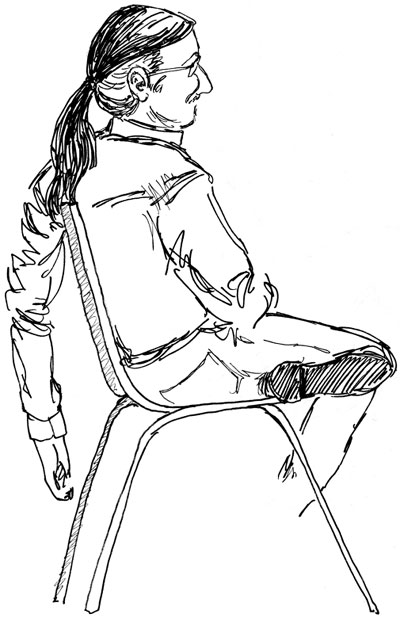
Today we get to know Jana Hollingsworth, a long-time subscriber to Seattle Opera and one of the supernumeraries in our current production of Fidelio. (Left, Jana embraces supernumerary Patrick Gerrells in the final scene of Fidelio, photo by Elise Bakketun.) A huge fan of opera, Jana is also an artist, who can frequently be found sketching rehearsals of the Seattle Gilbert and Sullivan Society, as well as at Seattle Opera events. Below, we learn more about her fascinating background, and take a look at some of her sketches.


What made you want to be a super in this production of Fidelio? Do you have a favorite moment in this opera?
The opportunity arose, and what opera fan wouldn’t want a chance to be a part of the action? Also, I saw this production of Fidelio when Seattle Opera did it before, and one of the problems with being in a show is that one doesn’t get to see the show. Since I’ve seen this production before, that’s not as big an issue.

I’ve seen Fidelio twice before, both productions set in modern times, and it always strikes me how contemporary this opera is. It’s over two hundred years old, but politics and human relationships really don’t change that much. I love history—I usually read it in preference to fiction—and seeing Fidelio reminds me of how we’re still working out things that happened back in the French and American Revolutions. I don’t know that I have a favorite moment, but the Prisoners' Chorus in the first act is just thrilling.

Marcy Stonikas as Leonore in Fidelio. Stonikas sang the Sunday matinee performance on October 14.
Sketch by Jana Hollingsworth; Photo by Elise Bakketun

Has the experience of being a super changed any of your previous perspectives on opera?
Mainly it gave me a greater appreciation for how big and complicated the whole business is. I’ve been involved in a small way with Seattle Gilbert and Sullivan Society productions for nine years, so there wasn’t anything surprising; Fidelio was just enormously larger and more complex.

How did you first become interested in opera?
I always say that if it weren’t for Gilbert and Sullivan I wouldn’t be here. That’s what got me started on opera. I discovered G&S in a big way in college in Bellingham in the ‘70s, first by reading the libretti. I’m a words person, which is a bit strange in an opera buff. I got all the D'Oyly Carte recordings, then started looking for more opera in English; I found Purcell but not a lot else. I listened to the Texaco opera broadcasts on radio; I enjoyed them, but I wasn’t really able to follow the stories properly.

Then I moved to Seattle from Port Angeles, where my family is, in the fall of 1983 to start graduate school at the UW, and I got season tickets to Seattle Opera. This was before captions, so I went to see the opera-in-English series. I have this strange idea than an opera is a play, and there’s not much point in seeing a play if you don’t know what the people are talking about. To me, it’s about drama. If all I wanted was music, I could get more music for my money at the Symphony. For me, opera is theater pushed to the nth degree by this incredible music.


Greer Grimsley, in rehearsal for Fidelio, drawn first in pencil and then inked with Faber Castell pens.
Sketch by Jana Hollingsworth

How did you begin sketching opera rehearsals?
I’ve been a member of the Seattle G&S Society since the late ‘70s, and attend their shows faithfully every year. After I moved to Seattle I began attending their other functions, and worked as a volunteer in the front of house. At one of their events I was talking to the producer, Mike Storie, and in the course of the conversation he told me it would be all right if I came to rehearsals as a guest. I was rather shy about it, and I brought my sketchbook mainly so I would have an obvious reason for being there, if anyone wondered who I was. It’s also a good way to start conversations.

They were doing The Gondoliers that year, and had the orchestra on stage, behind the actors, and used video for the maestro, Bernie Kwiram, and singers to see one another. At the last minute, the person who was going to run the video camera from the house had to cancel, and Mike said, “Well, Jana knows the show.” I took over that job, which meant I didn’t have to give up being involved once the show moved to the theater. Since then my official job with Seattle G&S has been to assist with in-house video. And I keep on doing rehearsal sketches for my own entertainment, and to keep in practice.

Clifton Forbis as Florestan in Fidelio.
Sketch by Jana Hollingsworth; Photo by Elise Bakketun

Do you have a background in art?
The sketches from life I’ve been doing on and off since I was in high school. I wanted to be an artist, largely inspired by my hobby of comic book collecting, though my talent is actually more for writing than drawing. I took art classes in school, but I didn’t want to live the life of a freelance artist. Since I’m also a map-lover I decided to become a cartographer—making maps is an art, too!—and got my masters in geography, specializing in cartography at the UW, which was one of the three top schools for cartography in the country at the time. I worked making maps for a number of years, but that job disappeared, and I now work as a paper-pusher in the insurance business. It’s a good enough job, but I have to do something to remind myself I’m an artist, so I keep up with the sketches.

I don’t consider myself highly talented as an artist; it’s mostly hard work and practice. Drawing is a skill, after all. I took art classes at the Gage Academy back when it was called the Seattle School of Realist Art, and I’ve studied from books, but otherwise I just keep working at it. In the late ‘80s and early ‘90s I did a comic strip called “Pagan Cowboy Joe” in the Neo-pagan magazine Green Egg, but despite my comic book background, I find I’m not particularly good at drawing things directly from my imagination. It’s much easier for me to draw what I see, and that’s what I mostly do these days.

Rehearsal sketches are great because they’re un-posed and spontaneous, but people keep coming back to the same positions and same expressions, so I can continue working on sketches I’ve started but have had to abandon because the person moved. The completely unsuccessful drawings, of course, get torn out of the sketchbook and thrown away. Besides G&S rehearsals, I also take my sketchbook to other places where people are gathered, particularly to meetings of the 36th District Democrats, with whom I am active. I wish the 36th District Republicans had a sketch artist, so we could have a joint show. Faces of the 36th District! As it is, all my drawings, theatrical and political, just live in my sketchbooks.

Supernumerary Patrick Gerrells, who plays Hollingsworth's prisoner husband in Fidelio. "I enjoy my three seconds or so at center-stage with him when I discover him waving the flag," she says.
Sketch by Jana Hollingsworth

Do you have any favorite productions from your almost 30 years as a Seattle Opera subscriber?
It’s hard to pick out individual shows. If I try, I’m sure to forget some of the best—most of them, in fact. After I saw Die Meistersinger, I went around for a week afterward saying to myself, “Damn, that was good!” And I still remember the version of The Barber of Seville which included the slow-motion brawl, and Figaro going around setting the action in motion at the beginning of each act. The Italian Girl in Algiers sticks in my mind, and the recent Fledermaus with the Wagnerian singers. I notice they’re all comedies. I love the tragedies, too, but everyone raves about them. I have a real fondness for comedies, partly because I started out as a G&S fan, but also because they’re less common. When one does show up, and is done well, it’s always a treat. If I could have only one opera recording, it would probably be The Marriage of Figaro, because it’s such a perfectly wonderful comedy.

Friday, October 19, 2012

Meet our Supernumeraries:
ROSEMARY LEONG-MILLER

Part of what makes Seattle Opera's production of Fidelio so exciting is the participation of dozens of supernumeraries (non-singing volunteers) from our community. They storm onstage in full force at the end of the opera, when the townspeople break down the prison walls and search for their loved ones. To cast this group, Stage Director Chris Alexander held auditions earlier this fall (watch the video HERE). Today we hear from Rosemary Leong-Miller (right, with red scarf, photo by Elise Bakketun), one of the supers who was selected through that process. Rosemary is coming full circle with this production; Fidelio was her first opera, back in 1980, and Chris Alexander is one of her favorite directors. She has been a volunteer, a longtime audience member, a donor, and a staunch friend of Seattle Opera for many years.

What is your role as a supernumerary in Fidelio?
Roles were determined by gender. Men can be camp guards, prisoners, members of the press, or a townsperson, and women are members of the press or part of the town. I am a townsperson, although I think it would have been fun to be cast as a detainee, kind of like Aung San Suu Kyi.

What do you like about being a super?
I like the process of seeing the opera coming together. I've had the opportunity to watch a piano technical rehearsal, followed by a dress rehearsal, and then the performance. It's interesting to see changes between the performances. By being a super, one experiences the entire development of a scene. Of course, it's REALLY wonderful listening to this great cast and chorus perform every night in rehearsals and on stage.

Have you been a super before?
No, this is my first time. And, I must add, it's a real honor.

What did you have to do in tryouts?
Our stage director, Chris Alexander, explained the scene to those of us who came to Seattle Opera’s rehearsal studio for the auditions. While a piano accompanied us, we broke through the prison walls and ran into the courtyard to look for our loved ones who had been imprisoned. Chris randomly assigned us to either find or not find our family member. I am one who doesn't find them in the courtyard, so I search the cells, and come out a little teary-eyed.

What do you like about Beethoven’s music?
Beethoven's music is powerful, and passionate. It moves you! Especially if you contrast it with the music that came earlier, of Mozart, or Haydn. The earlier music from the Classical Era was beautiful or interesting, but as you know, Beethoven marks the transition from the Classical to Romantic Era in music. You feel his music. He can make you want to cheer, like we do when we run into the courtyard.

What do you like about opera in general?
I love opera because opera has it all, not just music, not just voice. Great opera demands a great conductor with a good orchestra and singers, but opera in recital doesn't have the same impact as a wonderfully staged production with sets and costumes. If you add singers who can act, it's a live performance that just can't be beat.

Do you remember the first production you saw at Seattle Opera?
Of course! It was Fidelio in 1980. It's a great first opera.

Do you have a favorite production?
There are two Chris Alexander productions, Ariadne auf Naxos and Tales of Hoffman, that I loved and want to see again. And even though it isn’t my favorite opera, I'd have to add this summer's Turandot. Of course, our "Green Ring," and I'll never forget the Rusalka with Ben Heppner and Renée Fleming.

-- Interview by Jessica Murphy

Friday, October 28, 2011

A Supernumerary's View:
Meet AMIT MITAL, Trustee, Picador, and Shoeshine Boy

Amit Mital (left), Corporate Vice President at Microsoft by day, transforms into another identity at night, at least for the past few weeks--he's appearing as a supernumerary, or non-singing extra, in Seattle Opera's production of Carmen. Amit has been a member of Seattle Opera's Board of Trustees since 2009 and is a veteran supernumerary. He gives us the inside scoop on the planned (and unplanned!) adventures that make being a super so rewarding.

I have been a supporter of the opera for years and being a super(numerary) in Carmen has been an exhilarating experience. Carmen is a unique opera – timeless music, an enduring story, and many strong characters. The opera evolves during the show from a light comedy to a love story to a “soap opera” to a tragedy--all in the space of a few hours. The unexpected part of my participation has been seeing how the opera has evolved from performance to performance. Perhaps it’s the intense familiarity from the many rehearsals and performances, or getting to know many of the performers personally, or perhaps it’s the performers themselves deeply filling out their roles, but every performance has a nuance, an insight, a unique moment of unexpected beauty.

Supernumeraries Amit Mital and John Smilgin in Act One of Carmen (Elise Bakketun, photo)

In Act 1, I play a shoeshine boy. My cohort John Smiglin plays a lemonade vendor, and we’ve lately been pushing our roles just a little. His on-stage hijinks and creative improvisation are lots of fun. The "Habenera" scene in Act 1 is really magical. That’s when Carmen first comes on stage, and her song "L’amour est un oiseau rebelle" is awesome to experience from feet away. Anita Rachvelishvili and Malgorzata Walewska both sing it beautifully – but also very differently. It’s fun to see their different interpretations of the scene – how they flirt with the soldiers, how they thrust the flower at Don Jose.

Amit Mital as the Shoeshine Boy (Elise Bakketun, photo)

Act 2 is my most involved scene. I play the proprietor of the tavern, and have a fair amount of interaction with the principals. One of them (I’m convinced) has decided to try to get me to lose my composure on stage by whispering absurdly funny comments onstage. Each performance is now a running challenge to keep a stern, businesslike demeanor while waiting for the next zinger.

In Act Two, Amit Mital (Lillas Pastia) plots with Andrew Stenson (Remendado) and David Krohn (Dancaïre); Elise Bakketun, photo

Last week, I had a minor wardrobe malfunction. In Act 4, the other supers and I play Picadors. We have these outstanding, elaborate costumes in which we march on stage. The other night I arrived backstage without my hat – and without enough time to retrieve it from the dressing room. In an impressive display of calm, professional quick thinking, Mike Egan, our Assistant Stage Manager, asked all Picadors to remove our hats. Fine for most of us--except John, who was experiencing a bad case of helmet head that night!

Entrance of the Picadors (with hats, the night this photo was taken!) - Elise Bakketun, photo

Participating in Carmen “from the inside” has been an outstanding experience. The cast is extraordinarily talented and we’ve had a lot of fun working together. Seattle Opera has put on a truly remarkable production, and I am very grateful for the experience.

Post by Amit Mital