Showing posts with label Christopher Alden. Show all posts

Wednesday, May 11, 2016

Praise for The Flying Dutchman

Rebecca Nash (Senta). Philip Newton photo
"(Stage Director) [Christopher] Alden returns to Seattle after a long hiatus. He was last invited here for a Don Giovanni in 1991 that reportedly generated a heated audience backlash. Kudos to general director Aidan Lang for inviting him back: Dutchman, which closes Lang's second season at the helm, signals a serious commitment to opera and is the finest production the company has staged to date under his watch."- Bachtrack 

"['The Flying Dutchman'] clocks in at under two and a half hours (without intermission)... the impassioned singers, the clever staging and the imaginative sets are so consistently engaging that Seattle Opera’s performance just speeds by." - The Seattle Times

Members of the Seattle Opera Chorus in The Flying Dutchman. Philip Newton photo
"On Saturday night in Seattle, in a revival of this Canadian Opera Company 1996 production, what happened on stage can only be described as stunning ... I was left gobsmacked unable to write-so moved I was by this show. It has taken me 24 hours to recover." - National Opera Journal

"Director Christopher Alden makes full use of the ingenious Allen Moyer set, with elements that quickly switch locales from shipboard to shore without any major breaks in the action. Anne Militello’s inventive lighting designs underscore and clarify the story line with jaw-dropping effects." - The Seattle Times

Seattle Opera presents The Flying Dutchman. Philip Newton photo 
"Seattle Opera’s production of Wagner’s The Flying Dutchman opens with one of the most arresting curtain-raisings I’ve seen from the company: the cast filling Allen Moyer’s set, a cavernous box-within-a-box that is tilted 10 degrees or so off level. It’s an immediate cue that this isn’t going to be a traditionalist staging..." - Seattle Weekly 

"The Seattle Opera Chorus sang with gripping vitality, even while executing some [vigorous choreography]." - The Queen Anne News

"Wagner intended the opera to be presented without breaks between acts and the Seattle Opera in this production honors his 'through-composed' vision to great effect. (And for those who were a little scared of being subjected to 2.5 hours of uninterrupted opera the program likened it to the length of time we all have sat through a movie)." - The Seattle Times

Nikolai Schukoff (Erik). Philip Newton photo
"This cast boasts two excellent tenors with fresh, flexible, lovely voices: David Danholt as Erik, Senta’s betrothed, rightly peeved when she decides to wed the Dutchman, and Colin Ainsworth as the ship’s Steersman. Danholt was a winner of the Seattle Opera’s 2014 Wagner Competition, Ainsworth is making his company debut; I hope they both return soon and often." - Seattle Weekly

"In Saturday’s opening-night cast, the great strength and experience of the principal singers brought an unmistakable authority to their performances." - The Seattle Times

"The Dutchman was played on this night by Greer Grimsley. Grimsley has a swarthy dark voice that while powerful, is also versatile. It is easy for these Wagnerian singers to belt their way (at their peril) through these roles, but Grimsley always finds the color and the essence of the character." - National Opera Journal

Greer Grimsley as The Dutchman. Philip Newton photo
"In his Seattle Opera debut, Nikolai Schukoff as Erik, the huntsman in love with Senta, was as much the star of the evening as Grimsley and Nash. With his warmly expressive tenor, Schukoff was heart-rending in Act 3 reminding Senta in vain about her previous vow to him of love and fidelity." - The Queen Anne News

"In Saturday’s opening-night cast, the great strength and experience of the principal singers brought an unmistakable authority to their performances. The Dutchman, bass-baritone Greer Grimsley, is a familiar figure here (most impressively as Wotan in Seattle Opera’s “Ring”); he probes every nuance of the title role as a captain doomed to sail the seas in a ghost ship until he is redeemed by true love. With Grimsley’s commanding stage presence and resonant voice, this is a role that suits him admirably, and one he has frequently sung. The experience shows." - The Seattle Times

"Allen Moyer's unit set was an austere rectangular box dominated on one side by a massive steering wheel and a metal spiral staircase on which the Dutchman's 'ascension' played out in the denouement. The exaggerated tilt of the box recalled the Expressionist atmosphere of films like The Cabinet of Dr Caligari. In the opening scene this served handily as a 'realistic' representation of Daland's storm-tossed vessel." - Bachtrack

Members of the Seattle Opera Chorus in The Flying Dutchman. Philip Newton photo

"His Senta, Australian soprano Rebecca Nash, is making her Seattle debut — and what an interesting debut it is. Nash is a passionate singing actor with a voice of considerable heft and power." - The Seattle Times

"The Steersman, Colin Ainsworth, [was] the most lyric voice on the stage. Vocal beauty is still important in Wagner, and Ainsworth brought loads of it." - National Opera Journal

"Nikolai Schukoff, as her unsuccessful and hapless suitor Erik, is an ardent singer who becomes a tragicomic figure in this staging, with exaggerated attitudes of suffering that draw some audience laughter. (Alden has him attempting suicide in several positions with a rifle whose barrel is too long for the task.) You’d think that chuckles might be inappropriate in this ultraserious opera, but they humanize the characters and give more poignant depth to the denouement." - The Seattle Times 

Wendy Bryn Harmer (Senta) and Alfred Walker (The Dutchman). Philip Newton photo
"... Wagner was well aware of the dangerous potential art possesses when the goal is no longer escapist entertainment. So is director Christopher Alden, whose production (originally created for Canadian Opera Company two decades ago) mirrors the young composer's sense of thrilling new horizons beyond routine and convention. With a cast of powerhouse singers, this Dutchman sustains an arc of high-voltage tension, refusing to loosen its grip until the final blackout." - 
Bachtrack 

"As Senta’s father, the sea captain Daland, Daniel Sumegi creates a memorable portrayal with his mighty voice and his deft acting. Colin Ainsworth is a lyrical Steersman and a highly effective actor; Luretta Bybee does fine work in the shorter role of Mary." - The Seattle Times

Colin Ainswroth (Steersman). Philip Newton photo
"Conductor Sebastian Lang-Lessing, who made his Seattle debut with the company’s 2014 International Wagner Competition, coaxed vivid and exciting performances from an orchestra that knows this composer inside and out." - The Seattle Times

"Sunday’s alternate cast created a remarkably different show. In the title role, Alfred Walker was a strong actor with a warm tone that didn’t quite have the heroic presence that Wagner requires. Wendy Bryn Harmer was a standout Senta with a big, radiant voice; David Danholt (one of the winners of Seattle Opera’s 2014 International Wagner Competition) sang with artful clarity as the ill-fated Erik." - The Seattle Times

Rebecca Nash (Senta), Daniel Sumegi (Daland), Luretta Bybee (Mary). Philip Newton photo
Remaining performances of Seattle Opera's The Flying Dutchman: May 11, 14, 18, 20, & 21. Tickets & info: seattleopera.org/dutchman. #SODutchman 


Wednesday, May 4, 2016

What Comes Ashore

Rebecca Nash as Senta. Philip Newton photo
Jessica Murphy Moo
Perhaps a title like Senta wouldn’t have worked as well as The Flying Dutchman. Not nearly as much name—or myth—recognition, not nearly as much intrigue. And Senta and the Flying Dutchman sounds like a circus act. But the truth is that this opera is as much about Senta as it is about the man she loves.

Both are outsiders—the Dutchman in the form of a refugee who wants to find a way in; Senta in the form of a rebellious young woman who wants out. But neither entrance nor exit is given lightly in this small community. Easier to stick with the status quo; better to stand by, better to conform.

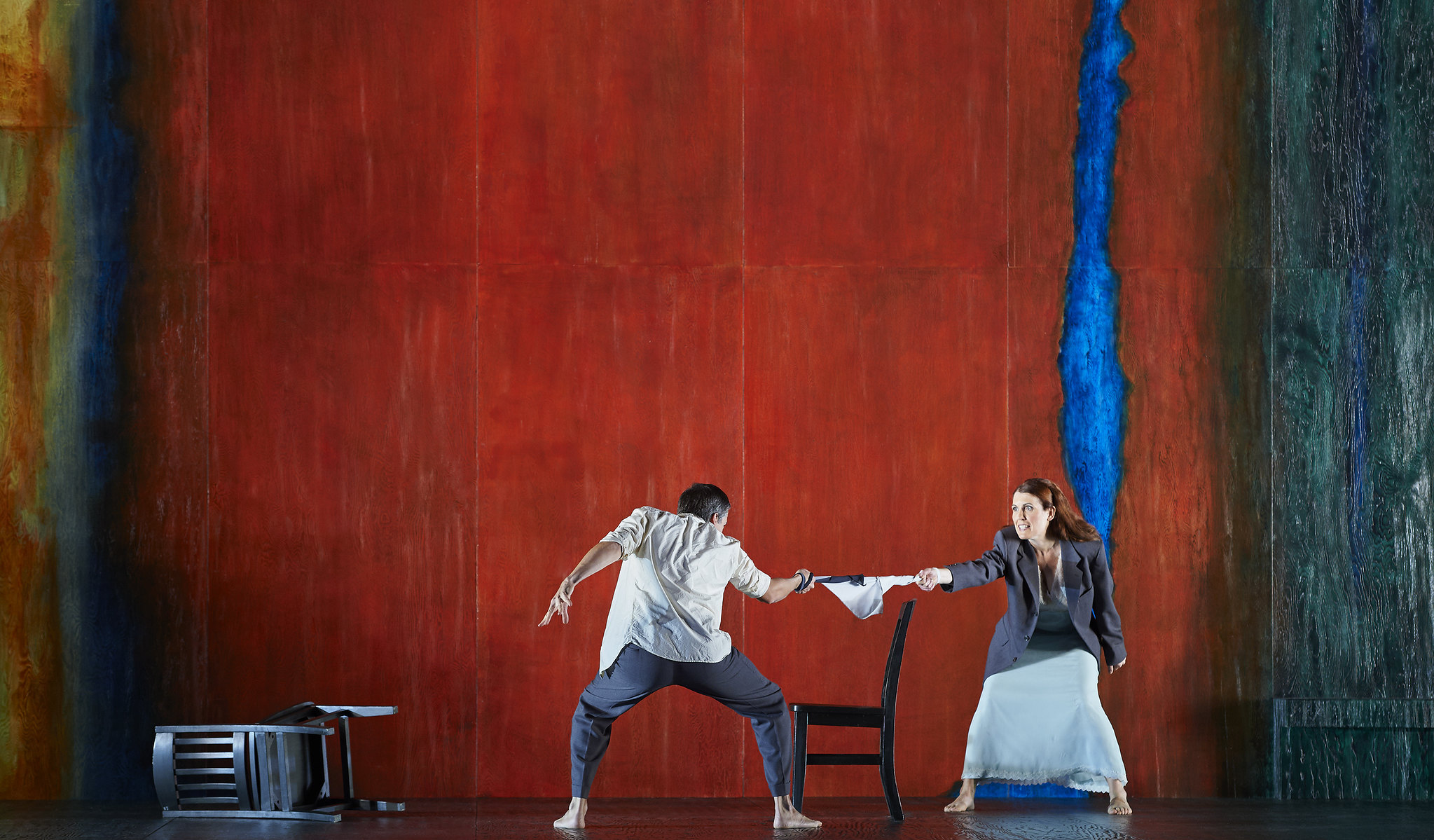
This idea—that the individual could be seen as a threat to a closed, communal society—was the starting point for stage director Christopher Alden and set and costume designer Allen Moyer when they first conceived of this production for Canadian Opera Company in 1996. And the production’s success and long life may have everything to do with their interest in this timeless theme. (In the past twenty years the production has been presented in Toronto three times and at many other companies across the US and abroad.)

Once they had their central focus, Alden and Moyer looked for examples of closed societies and periods in history characterized by these tensions. What surfaced? The 1920s, that period after World War I, when German expressionism—in art and in early German cinema—emerged, just before Nazi Germany would censor it as “degenerate.”
Seattle Opera's Sentas: Wendy Bryn Harmer (left) sings May 8, 14 & 20 and Rebecca Nash makes her company debut May 7, 11, 18 & 21. 

You’ll see this artistic influence—which Alden admits was a personal influence—everywhere in this production. Senta’s bob (notice she’s the only one who’s got one) is the 1920s hairstyle of the emancipated woman. The Dutchman’s portrait that so captivates Senta is an actual block print engraving, “Man on a Plain” by Erich Heckel (influenced by Edvard Munch). And the exaggerated makeup with charcoaled eyes is a nod to early German film (think The Cabinet of Dr. Caligari) pictured below.

The set works in an expressionistic way as well. You will see the space transform from a ship interior to a meeting hall, one that looks not unlike a closed box, imparting all the claustrophobia we might imagine of life in such a space. The floor tilts—suggesting a ship’s movement at sea and, when on land, Moyer says it was a way for him to say they lived in a world that had some cracks in its foundation; “it’s crushing a little under its own weight.”

The Cabinet of Dr. Caligari
And of course Wagner’s music informed the design and concept as well. “Every idea comes from the music,” says Moyer. “It’s as if it’s the manifesto; it’s your brief. You want the set to look like the music sounds."

With Wagner the scale of that sound is not small. So Moyer didn’t want to diminish that scale by putting a smaller-than-life boat onstage (a ship on a theater stage will always need to be smaller in dimension than the real thing). He wanted something suggestive—here we go again, something expressionistic—that would provoke the audience’s imagination to match the music’s larger-than-life scale.

“Wagner’s pieces reach into areas of the human experience that go to some dark, extraordinarily intense places,” says Alden. “That’s why people become so obsessed with Wagner operas. Very few [operas] go to such extreme places.”

The Canadian Opera Company's The Flying Dutchman. Gary Beechey photo
Alden is interested in taking audiences to that dark territory, beneath the surface level narrative to a place that invokes the subconscious.

“Senta is fixated on the way to escape this world,” Alden says. “She lives in the real world but so much in the fantasy world; these two worlds collide as she goes deeper and deeper into her fantasy.” And as these two worlds—the real and the unreal—collide, Alden says there is a “crack”: “And out of this crack come these demon forces that invade reality.” Take, for example, the Dutchman’s entrance in scene two, as if he’s coming from another world, or the moment when the Dutchman’s undead crew puts a serious damper on the sailors’ party in scene three.

What are these otherworldy forces supposed to be? Well, Alden and Moyer would rather leave the question open-ended. This piece is not meant to direct you to easy tie-the-end-of-the-knot interpretations. Instead, the idea is to provoke your inquiry. What happens—both to the individual and the society—when the outsider comes ashore?

The question persists for Alden, who says he’d like to do a Dutchman that focuses on the plight of modern refugees all over the world as they try to escape their impossible circumstances. The analogy certainly fits. What happens when the outsider comes to our shore? If it is a question that makes us squirm, makes us wonder how exactly we are implicated, perhaps the art is doing its job.

Dutchman director Christopher Alden in rehearsal. Jacob Lucas photo
.


. 


Friday, November 6, 2015

Seattle's Opera-World Gazette: 11/6/15

Introducing a new series of blog posts in which we check in on what our Seattle Opera artists are up to elsewhere. Please let us know what you think in the ‘Comments’ area!

We’ve closed The Pearl Fishers in Seattle, but all over the world our artists are keeping busy as the fall opera season continues. Here’s the latest on some folks who will be coming to Seattle soon:

Mary Elizabeth Williams sings her first Lady Macbeth.
In Switzerland, our amazing Abigaille from this summer’s Nabucco added another scary early Verdi killer to her repertoire: Mary Elizabeth Williams debuted as Lady Macbeth at the Theater St. Gallen. Watch footage of her hand-washing mad scene in this video trailer starting at 3:22:

Macbeth from theatersg on Vimeo.

Mary Elizabeth Williams returns to Seattle in February as Queen Elizabeth in Mary Stuart.

Joyce El-Khoury and Christopher Alden in Toronto.
Joyce El-Khoury makes her Seattle debut in February as Mary Stuart. The Lebanese soprano sings her final performance as Violetta in Canadian Opera Company’s La traviata in Toronto tonight. Tomorrow, COC closes its run of a fascinating double-bill: a new opera by Canadian composer Barbara Monk Feldman on Pyramus and Thisbe paired with two small pieces by Claudio Monteverdi, Renaissance Italy’s opera pioneer. Director Christopher Alden, whose COC Flying Dutchman comes to Seattle next May, staged this double-bill; here are some of the photos: Pyramus and Thisbe

Duane Schuler lights Houston’s Tosca, starring Weston Hurt.
If you’re in Houston, don’t miss the chance to enjoy the work of Seattleite and famed lighting designer Duane Schuler, who comes home to light our upcoming Marriage of Figaro in January. Singing Scarpia at Houston's Saturday, November 14 performance is Weston Hurt, who terrorized the Israelites as Nabucco in Seattle this summer, and who returns to administer extreme unction to Mary Stuart this February—he sings the role of Talbot in our upcoming production of Donizetti’s political thriller.

Morgan Smith sings Starbuck in LA Opera’s Moby-Dick.
The original production of Jake Heggie’s popular whale-tale comes to LA Opera starting tomorrow, November 7, with Seattleite Morgan Smith reprising his role as the tormented first mate Starbuck. Smith, who just created the role of Jim Crowley in Seattle Opera’s world premiere of An American Dream, returns as Count Almaviva in our upcoming Marriage of Figaro. (When he was a Seattle Opera Young Artist, back in ’99, Smith sang Figaro!)

Morgan Smith as Starbuck and Joshua Guerrero as Greenhorn in LA Opera’s production of Moby-Dick (Photo: Craig T. Matthew/LA Opera)