Listen to a quick overview of Lucia di Lammermoor in this brief talk by Education Associate Seneca Garber. Hear Garber give the key plot elements and musical highlights of this production, all in just 4 ½ minutes. To see a full preview of this upcoming opera, view our website calendar.
Lucia di Lammermoor Preview Podcast
This preview along with many other exciting audio clips can also be found on our iTunes Podcast Channel.
Friday, October 8, 2010


Thursday, October 7, 2010
Fountain of youth...or blood.
Know any teenagers? Understand them?
One version of the Reason Why Blood is Spilled in Lucia di Lammermoor, offered by General Director Speight Jenkins in a recent talk about the opera, is that the characters are just hot-blooded Italians. For the sake of thought-provoking public discourse, I thought I'd offer a different perspective for your consideration, with a slice of science on the side.
In an earlier blog post ("More than just a Pretty Tune"), I mentioned that adolescence plays a role in all three versions of Lucia's story (the original, true-to-life tale of Janet Dalrymple, Walter Scott's ill-fated Bride and Donizetti's unlucky lady) since every character with the exception of the priest Raimondo is a young adult.
Like the fountain onstage in Act I, Scene 2 that suddenly transforms from placid water to roiling blood during Lucia's entrance aria "Regnava nel silenzio," teens are perhaps one of the most complex and unpredictable organisms on Planet Earth. Why, you ask? Not enough sleep? Too many Hormones? Obsessed with a technological universe that seems to older folks completely devoid of human interaction? Perhaps these, and more.
 Scientifically, I understand that with the advent of Magnetic Resonance Imaging (MRI) we're now able to see what parents have known since time immemorial: the teenage brain is a Work In Progress. It probably goes without saying, but here's what this might mean to you, and to the characters in Lucia.
Recent studies suggest that the frontal lobes - our brain's home for planning, impulse control and reasoning - do not fully mature until adulthood. Parietal and temporal areas, which mediate spatial, sensory, auditory and language functions appear largely mature in the teen brain. I'm pretty sure this means that your recalcitrant young adult can certainly hear what you're saying, despite any indications to the contrary, but blame their immature frontal lobes for the seemingly well-developed ability to completely ignore you!
 Even more importantly, functional MRI studies are now able to scan subjects' brain activity while they are utilizing their senses: sight, sound, smell or performing simple cognitive tasks. In one research project at Harvard University, subjects were examined while they identified emotions on pictures of faces. Young teens, who characteristically perform poorly on the task, activated the amygdala within the temporal lobes, a brain center that mediates fear and other "gut" reactions, more than the frontal lobe. As teens grow older, their brain activity during this task tends to shift to the frontal lobe, leading to more reasoned perceptions and improved performance.
In the opera, Enrico seeks to solve what might be a temporary problem of failing fortunes and ill-advised political association with a permanent solution. I believe that in his mind, the only conceivable solution is to marry his sister to someone she doesn't love, despite the fact that she's pledged her eternal love to another young man. (OK, so he's their family's mortal enemy, but that might be splitting hairs.) Lucia, rendered completely powerless in the marriage contract scene of Act 2, Scene 2, reasserts control by the offstage murder of her new husband Arturo, then loses all connection with reality and dies. Despite Raimondo's pleadings during the sextet that Edgardo will find someone else to love, he commits suicide after hearing the bells toll news of Lucia's death.
Back in real life, we've heard a lot about permanent solutions recently with the spate of suicides in young people who have been targeted and victimized by bullies, online or in person. For these teens, their suffering seems inescapable, and suicide the only way out. Though any kind of help will come too late for the Dalrymple and Lammermoor clans, there is hope that with awareness and a focus on suicide prevention, today's fountains can once again run clear.
One version of the Reason Why Blood is Spilled in Lucia di Lammermoor, offered by General Director Speight Jenkins in a recent talk about the opera, is that the characters are just hot-blooded Italians. For the sake of thought-provoking public discourse, I thought I'd offer a different perspective for your consideration, with a slice of science on the side.
In an earlier blog post ("More than just a Pretty Tune"), I mentioned that adolescence plays a role in all three versions of Lucia's story (the original, true-to-life tale of Janet Dalrymple, Walter Scott's ill-fated Bride and Donizetti's unlucky lady) since every character with the exception of the priest Raimondo is a young adult.
Like the fountain onstage in Act I, Scene 2 that suddenly transforms from placid water to roiling blood during Lucia's entrance aria "Regnava nel silenzio," teens are perhaps one of the most complex and unpredictable organisms on Planet Earth. Why, you ask? Not enough sleep? Too many Hormones? Obsessed with a technological universe that seems to older folks completely devoid of human interaction? Perhaps these, and more.
 Scientifically, I understand that with the advent of Magnetic Resonance Imaging (MRI) we're now able to see what parents have known since time immemorial: the teenage brain is a Work In Progress. It probably goes without saying, but here's what this might mean to you, and to the characters in Lucia.
Recent studies suggest that the frontal lobes - our brain's home for planning, impulse control and reasoning - do not fully mature until adulthood. Parietal and temporal areas, which mediate spatial, sensory, auditory and language functions appear largely mature in the teen brain. I'm pretty sure this means that your recalcitrant young adult can certainly hear what you're saying, despite any indications to the contrary, but blame their immature frontal lobes for the seemingly well-developed ability to completely ignore you!
 Even more importantly, functional MRI studies are now able to scan subjects' brain activity while they are utilizing their senses: sight, sound, smell or performing simple cognitive tasks. In one research project at Harvard University, subjects were examined while they identified emotions on pictures of faces. Young teens, who characteristically perform poorly on the task, activated the amygdala within the temporal lobes, a brain center that mediates fear and other "gut" reactions, more than the frontal lobe. As teens grow older, their brain activity during this task tends to shift to the frontal lobe, leading to more reasoned perceptions and improved performance.
In the opera, Enrico seeks to solve what might be a temporary problem of failing fortunes and ill-advised political association with a permanent solution. I believe that in his mind, the only conceivable solution is to marry his sister to someone she doesn't love, despite the fact that she's pledged her eternal love to another young man. (OK, so he's their family's mortal enemy, but that might be splitting hairs.) Lucia, rendered completely powerless in the marriage contract scene of Act 2, Scene 2, reasserts control by the offstage murder of her new husband Arturo, then loses all connection with reality and dies. Despite Raimondo's pleadings during the sextet that Edgardo will find someone else to love, he commits suicide after hearing the bells toll news of Lucia's death.
Back in real life, we've heard a lot about permanent solutions recently with the spate of suicides in young people who have been targeted and victimized by bullies, online or in person. For these teens, their suffering seems inescapable, and suicide the only way out. Though any kind of help will come too late for the Dalrymple and Lammermoor clans, there is hope that with awareness and a focus on suicide prevention, today's fountains can once again run clear.
Wednesday, October 6, 2010
A Chat with Philip Cutlip
 Today we hear from baritone Philip Cutlip, who performs the role of Enrico as part of the Friday/Sunday cast of Lucia di Lammermoor. Cutlip has previously appeared at Seattle Opera as Harlequin in Strauss’s Ariadne auf Naxos, Maurice in Jake Heggie’s End of the Affair, and Marcello in Puccini’s Bohème. We had the chance to ask Cutlip about his ties to Washington, his thoughts on this production of Lucia, and how he feels about playing Lucia’s controlling brother.
You grew up in Ellensburg, WA, but now live in New York. Do you still have family in Washington, or visit your hometown?
It's true—I am an Ellensburger! In fact, my family moved there when I was less than two years old, so I consider myself the next best thing to a native. I grew up in Ellensburg, and spent summers there during my college years when I was at the University of Puget Sound. I finally moved away for good at 22 and have lived on the East Coast ever since. My parents are still in Ellensburg, my father having just retired from 40 years as a mathematics professor at Central Washington University. My mother was a speech therapist in various capacities. My brother and family live in Vantage, my sister and family are in Wedgewood, Seattle. She's been a pharmacist at the Bartell drugstore in Ballard for over 25 years! I love my times in Washington, whether for visits, or in conjunction with singing jobs. Though I've lived in New York City for nearly half my life now, I'll never consider myself a New Yorker. Washington’s outdoor activities and beauty are simply a part of me, and I hope someday to move back here.

Phil Cutlip as Marcello in Seattle Opera's 2007 La bohème (Rozarii Lynch, photo)
Let’s talk a little about Enrico, your character in Lucia di Lammermoor. To the audience, he isn’t the most likable of guys. But how do you feel about him personally? Can you empathize with him?
Let's just say Enrico is complex. He seems to be monomaniacal, driven to restore his family name at all costs—even at the cost of his sister's sanity and life. And even more significantly, his attempts to manipulate Lucia's relationship in order to turn the tide of his family's fortunes backfires, and we can only imagine poor Enrico falling on very hard times after the opera's conclusion. I empathize with Enrico's drives, but not with his willingness to compromise everything to achieve them. His remorse comes far too late for poor Lucia, even when he is temporarily swayed during the opera's famous sextet.

Philip Cutlip as Maurice Bendrix with Mary Mills as Sarah Miles in The End of the Affair (Bill Mohn, photo)
What is your approach to roles like this, for characters the audience is inclined to dislike? Do you enjoy exploring the darker territory, or would rather be the hero?
In fact, I haven't played so many purely “bad guys.” I have played roles whose virtues are questionable, whose motivations are dishonorable. Take, for example, Don Giovanni. He is both a magnetic and a hateful character. The challenge is, first of all, to show the facets of Giovanni's character; he is not simply bad or evil. He has weaknesses, but he also has the capacity for love—fleeting though it might be. There are, of course, more black and hateful characters, like the villains in Les contes d'Hoffmann, Méphistophélès in Faust, etc. So far, I have taken as much pleasure in my darker roles as my heroic ones. Variety keeps life interesting as an artist, too!
As far as music is concerned, what is your favorite part of Lucia to sing?
Enrico's principal scene is the most challenging and the most rewarding for me. It has his aria, “Cruda, funesta smania,” and the cabaletta, “La pietade in suo favore,” both of which are tremendously rewarding to sing and to act, as well. I also very much enjoy the duet section with Lucia—a chance to be really “bad,” and also to sing some extremely beautiful music with my Lucia, Davinia Rodríguez. And of course, the Sextet is truly a masterpiece, with each character expressing his or her own feelings, Enrico's being significant in that he is for the first time showing some remorse and pity for Lucia's situation.

Philip Cutlip as Harlekin with Jane Eaglen as Ariadne in Ariadne auf Naxos (Rozarii Lynch, photo)
You made your Seattle Opera debut as Harlequin in 2004’s Ariadne auf Naxos. Enrico in Lucia is, vocally, a heavier role. How have you felt your voice evolving since your debut?
I’m very pleased to look back at my progress vocally and as a stage actor in the past six years or so since Ariadne. My voice has indeed gained in strength and breadth since that time, and I am so pleased that Speight Jenkins expressed his confidence in me by giving me this Enrico.
Now that you’re into the third week of rehearsal, what are your thoughts on this production and its cast?
I feel very fortunate to be singing with an extremely accomplished cast. From the young artists singing supporting roles to the principals, I am surrounded by excellence. Davinia is a dream to listen to, and I have no doubt that this Lucia will be the first of many for her. I have really appreciated Bruno Cinquegrani's sensitive musical direction—he is a singer's conductor, who knows what we need in terms of phrasing and breath. The production itself provides a different take on the traditional Lucia setting, but without completely removing it from a basis in historic British territory, and I think it works very well to preserve the feeling of aristocratic tensions required by the plot. I think the set itself—a multi-tiered structure with spiral staircases and ample hiding places for eavesdroppers—will also provide a great thrill for the audience.
Tuesday, October 5, 2010
A Chat with Tomer Zvulun
 As rehearsals head into the home stretch, it’s time to check in with Tomer Zvulun, our stage director for Lucia. Zvulun, who hails from Tel Aviv, Israel, first joined Seattle Opera in the summer of 2006 as Assistant Director for Der Rosenkavalier. As resident Assistant Director for the next year and a half, he worked closely with many of Seattle Opera’s stage directors, returning as Stephen Wadsworth’s Associate Director for the 2009 Ring, and now making his debut as Director.
Tomer, why are you an opera director?
Whoa, that’s a big question! As a child, I was fascinated by theater and cinema. I discovered opera later, in my late teens, and when I did it was the biggest revelation of my life. Everything suddenly came together...it all made sense. The combination of story and music, of emotions and orchestration, this melding of thought and melody blew my mind. I realized that that’s what I wanted to do. So I left medical school--even though my parents wanted a son who’s a doctor--and decided to pursue opera.
I’ve never regretted it, because every day I discover something new. It’s not only the operas and stories and composers, but all the different people who come together to bring it to life. This is my fifth Lucia,and I’m still discovering things about the characters and story and interpretation because the people are different. And even if they’re not different, like Scott Piper here, who sang Edgardo for me in Cleveland, we’re discovering things we didn’t think Edgardo would do. It’s an endless journey, working on these great operas, and I still I feel I’m at the beginning of it and I‘m completely in love with it.
I know what you mean, about the allure of the art form. But why be a director?
Instinct, really. When I hear opera music, I get a clear image in my mind of what should happen at that music. And the flip side of that is, when I see things onstage and don’t agree with them, I’m always thinking of alternatives. If that happens in your brain naturally, you should be a director.

Zvulun's Seattle Lucia tomb scene will feature snow and umbrellas, as did his Cleveland Lucia tomb scene (Photo by Eric Mull/Ruppert Bohle)
Also, I believe directing comes from life experience. A director's job is to create life, so you need to live and to see as much as you can. If you are directing La bohème, it helps to know what being broke really means! Or it helps to understand what falling passionately in love is like and then have your heart broken. I am lucky in that I have had a very diverse life experience, growing up in Israel, serving as a medic in the army, and then wandering the world as a young artist. As an opera director, I use this life experience every day. I think that the best education a young director can have is to live: experience as many different cultures and perspectives as possible, and then figure out how to transfer that accumulated knowledge onto the stage. That furthered my education as much as working with directors around the country--such as my experience here in Seattle with great artists like Stephen Wadsworth, whose goal is always to bring this kind of life, this reality, to the opera stage.

Zvulun assisted Chris Alexander in staging Seattle Opera's 2007 Don Giovanni (Bill Mohn, photo)
By now you’ve staged each scene in Lucia, and are going through and refining your ideas. How’s it going?
I love working with this cast; they are always open to trying new ideas! I have a clear idea of what I want because I’ve done so many Lucias and I have been planning this specific production for more than two years--but if the initial idea doesn’t work, we make something up that fits their bodies, their physique, their ideas of the character.
Honestly, my favorite part of the process is this week. Everything is set, but now we’re revisiting it, finding new ways to make it more real, more visceral. I love it when performers won’t do something they don’t believe in 100%. Artists give stronger perfomances when their moves and gestures come from within, as opposed to when the director has imposed some idea from outside.
How is your Seattle Lucia different than the Lucia you directed for Opera Cleveland earlier this year?
The people are different. That’s where it all starts. The passion is the same; the violence and the mental breakdown of Lucia, hopefully that will be just as strong here. In fact, we have more time in Seattle to talk about the characters and what happens to them; and our dialogue is richer because we have two casts of very intelligent people.

Zvulun works with Aleksandra Kurzak (Bill Mohn, photo)
How would you characterize the differences between our two casts?
Aleksandra Kurzak, who plays Lucia on Saturday and Wednesday nights in Seattle, plays the role a little more shy and innocent than Davinia Rodríguez (on Sundays and Fridays), whose portrayal of Lucia is a little less naïve, a little more sensual. Both can work. Alex is a comedian, she’s been doing a lot of funny buffo operas by Rossini and Donizetti, so it’s very easy for her to get this lightness into her portrayal. Her Lucia is a charming little girl, we get into this teenager world she has at the beginning. Her ghost story is scary--but she’s also fascinated and attracted by the ghost, like in movies about vampires. The trap that one can fall into with Lucia is to make her look like a spineless victim or a crazy person from the beginning; we’re interpreting it that she just has a very active imagination. Her imagination just keeps going further and further, as she gets backed up to the wall by all these people who make demands of her, and her grasp of reality loosens as we go.
What’s your favorite opera?
I’m always in love with my next project. Right now I love Gounod’s Faust, because I’m doing a new co-production, for Atlanta and Indiana University. But I’m definitely most attracted by verismo--my favorite composer is Puccini; I adore La bohème and Butterfly. It’s interesting, Lucia starts as a bel canto opera, but in Act Two it becomes such a tight dramatic story that it suddenly feels like a verismo opera.

Zvulun directs Kurzak (Bill Mohn, photo)
You’ve been Assistant and Associate Director here at Seattle Opera in the past. What’s it like to come back, now as Director Director?
It’s wonderful! Everybody already knows me and I feel this great warmth and support from everybody at the company, from Speight Jenkins down to the volunteers. Everybody involved wants this production to be the greatest experience possible. It’s just nice to come home, back to people who know me, who understand what I want and expect. It feels very natural, but that’s because Seattle Opera is my artistic home--the place I learned my craft.
Lucia di Lammermoor: Director's Talk
See the cast in rehearsal - including lovers Lucia and Edgardo (Aleksandra Kurzak and Bill Burden) - as Stage Director Tomer Zvulun shares his vision for this new production. Tomer speaks out about the various singer debuts, praises the chorus, and explains the very important role of the choreographer in this opera.
To learn more about Seattle Opera's production of Lucia di Lammermoor, visit the Seattle Opera website.
To learn more about Seattle Opera's production of Lucia di Lammermoor, visit the Seattle Opera website.
Monday, October 4, 2010
A LUCIA Taste Test
Lucia di Lammermoor has many wonderful aspects, whether it’s the Romeo-and-Juliet-esque star-crossed lovers with Edgardo and Lucia or the breathtaking sextet with all of the voices coming together to create one of the most memorable tunes in opera. Of course, the real reason we go to a performance of Lucia is the mad scene; that divine moment (all 16 minutes of it) when the soprano gets to show off all the vocal fireworks and stunning coloratura that we’ve come to scrutinize under the closest of microscopes. The singer must have all the goods as a singer AND as an actress—no small feat.
One of the great joys of opera is revisiting a piece and hearing different singers interpret a role in very different ways. Today we’re putting you in the shoes of a General Director by auditioning three famous sopranos singing the most recognizable moment of the mad scene, the famous so-called "battle with the flute," and then voting for your favorite. This is the moment when Lucia, who has murdered her new husband, comes back on stage to interrupt the chorus's party with her hallucination that she and Edgardo are now happily married. In this scene, Donizetti eliminates the orchestra and has Lucia sing with a solo instrument (usually that aforementioned flute, but originally scored for a glass harmonica). This is the apex of bel canto madness; a lone woman, singing unaccompanied, confused and heartbroken. It may sound like the most beautiful music you’ve ever heard, but in this moment the audience shares the experience of a woman having a complete breakdown.
Our first soprano is none other than Maria Callas (1923-1977), a woman who almost single-handedly revived the style of bel canto opera. Here was a singer who colored every word that she sang with deep meaning. It’s not always the most beautiful sound, but it manages to convey the emotional torment that Lucia is suffering.

Our second soprano is from an early era, the famous Nellie Melba (1861-1931). These days she’s probably more remembered for the toast or the peach dessert named for her, but Melba was without a doubt one of the most recognized voices of her time. She has a very different sound than our first soprano; it’s lighter, perhaps conveying the innocence of the young Lucia. It’s also important to remember that prior to Maria Callas, Lucia was little more than a way for a performer to show off her vocal skills. Only later did directors and singers impose on the opera a deeper sense of psychological drama.

Our third and final soprano is Beverly Sills (1929-2007), who sang the role of Lucia at Seattle Opera in 1972. In her voice we hear the vocal nimbleness that can make bel canto so exciting. Again, she sounds as if her life has been sheltered and this is the first time she’s experienced such grief, unlike Ms. Callas who sounds as if she has lived through this experience of heartbreak once or twice before. In this recording, Ms. Sills is accompanied by the glass harmonica instead of the flute. Does this change the tone of the scene for you?

Any of these singers would be a wonderful choice for Lucia, but since this is an opera loosely based on Scotland and Highlander stories, I should say: “There can only be one!” It’s your turn to vote for your favorite and tell us who you would want to see and why.
-Seneca Garber, Education Associate
One of the great joys of opera is revisiting a piece and hearing different singers interpret a role in very different ways. Today we’re putting you in the shoes of a General Director by auditioning three famous sopranos singing the most recognizable moment of the mad scene, the famous so-called "battle with the flute," and then voting for your favorite. This is the moment when Lucia, who has murdered her new husband, comes back on stage to interrupt the chorus's party with her hallucination that she and Edgardo are now happily married. In this scene, Donizetti eliminates the orchestra and has Lucia sing with a solo instrument (usually that aforementioned flute, but originally scored for a glass harmonica). This is the apex of bel canto madness; a lone woman, singing unaccompanied, confused and heartbroken. It may sound like the most beautiful music you’ve ever heard, but in this moment the audience shares the experience of a woman having a complete breakdown.
Our first soprano is none other than Maria Callas (1923-1977), a woman who almost single-handedly revived the style of bel canto opera. Here was a singer who colored every word that she sang with deep meaning. It’s not always the most beautiful sound, but it manages to convey the emotional torment that Lucia is suffering.

Maria Callas.
Our second soprano is from an early era, the famous Nellie Melba (1861-1931). These days she’s probably more remembered for the toast or the peach dessert named for her, but Melba was without a doubt one of the most recognized voices of her time. She has a very different sound than our first soprano; it’s lighter, perhaps conveying the innocence of the young Lucia. It’s also important to remember that prior to Maria Callas, Lucia was little more than a way for a performer to show off her vocal skills. Only later did directors and singers impose on the opera a deeper sense of psychological drama.

Nellie Melba.
Our third and final soprano is Beverly Sills (1929-2007), who sang the role of Lucia at Seattle Opera in 1972. In her voice we hear the vocal nimbleness that can make bel canto so exciting. Again, she sounds as if her life has been sheltered and this is the first time she’s experienced such grief, unlike Ms. Callas who sounds as if she has lived through this experience of heartbreak once or twice before. In this recording, Ms. Sills is accompanied by the glass harmonica instead of the flute. Does this change the tone of the scene for you?
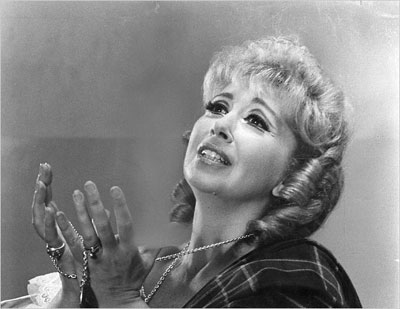
Beverly Sills.
Any of these singers would be a wonderful choice for Lucia, but since this is an opera loosely based on Scotland and Highlander stories, I should say: “There can only be one!” It’s your turn to vote for your favorite and tell us who you would want to see and why.

-Seneca Garber, Education Associate
Friday, October 1, 2010
How to Distinguish ROSSINI from BELLINI from DONIZETTI
Can you tell a Monet from a Renoir? Are you proud of your ability to differentiate Keats from Shelley? If you want to be a true Bel canto aficionado, train your ears so you can hear the difference between the music written, in those strict Bel canto forms, by the leading composers of the period: Rossini, Bellini, and Donizetti.
There’s more to Bel canto than those three, but the repertory of companies like Seattle Opera usually include operas by Gioachino Rossini (everyone loves his Barber of Seville, and we’ve done his Italian Girl in Algiers and La Cenerentola), Vincenzo Bellini (we’ve done his Norma and I puritani) and Donizetti (look at Seattle Opera’s Facebook Photo Albums for a retrospective with photos of the five Donizetti operas we’ve produced). Once you’ve learned what to listen for in Bel canto generally, spend some time figuring out the differences between these three great composers--and what makes each of them great.
 ROSSINI.
A nineteenth-century cartoonist has Rossini, who retired at the age of 40 after writing 40 operas in 20 years, waltzing away with a sack of money from the Paris Opéra, which is burning to the ground now that he has abandoned it.
Classical. According to most historians of music, the Classical period gave way to the Romantic period in the early nineteenth century. Bel canto opera straddles that shift. Rossini, whose great operas were written between 1813 and 1829, is best considered a Classical composer--in fact he quit writing operas, at age 39, because he couldn’t do the new Romantic thing that had become so trendy. Listen for Classical values in Rossini’s music: balance, symmetry, clarity, simplicity, formal grace and elegance. None of that Romantic emotional sloshing to be heard here!
Bravura performances. All of Rossini’s operas set up the singers as sports stars, showing off their special skills and ability to perform technically difficult bravura singing. Mediocre performers need not apply. What’s more, because Rossini’s Classical period music doesn’t teem with personal emotion, if the audience is going to invest emotionally in the drama they’ll need charismatic performers up there onstage to care about.
(Marilyn Horne, in a showpiece aria from Rossini's The Siege of Corinth)
The Rossini Crescendo. Rossini’s favorite musical trick is the crescendo, meaning “start soft and get loud”. He uses it most often in his comedies, to accompany increasing mayhem and craziness onstage. In The Barber of Seville you’ll hear several great Rossini crescendos, most famously Basilio’s “Slander” Aria, in which an enormous musical crescendo imitates the effect of an entire town rejecting and ostracizing an individual who gets slandered.
(Crescendo from end of Act One of La Cenerentola)

 BELLINI.
A more recent cartoonist has Bellini lighting the fire that will purge the Druid village of the sinful Norma in his most famous and popular opera.
Sweet melancholy. Unlike Rossini, Bellini excelled at indulging our emotions musically. All of his operas gravitate toward the same emotion, a Romantic sentiment which was culturally central when his music was all the rage in the 1830s: that sweet, sad, soft, sentimental melancholy of early Romanticism. It’s not about tragedy, it’s too pastel for that. It can feel like yearning, but it’s not a Wagnerian yearning for transcendence, it’s more like homesickness. Romance in Bellini is a gentle thing, more about the feeling you get when my breath tickles the hair on the back of your neck than interactions between other body parts.

All about the breath. Giuseppe Verdi made a telling, if not entirely charitable comment, about Bellini: “Bellini is poor, it is true, in harmony and orchestration, but rich in feeling and in an individual melancholy that was all his own. Even in his less familiar operas, there are long, long, long melodies such as no one ever wrote before his day.” The immense length of Bellini’s florid melodic lines--often compared to those of his great friend, Chopin--is one of the key identifying features of his music. It requires supreme breath control to sing these long lines, and many music historians have pointed out that Wagner got the idea of “Endless Melody”--not to mention those shattering, orgasmic climaxes that enormously long lines make possible--from listening to and conducting Bellini, his favorite composer.
(Jane Eaglen singing "Casta Diva" from Norma.)
Musical quality varies. Verdi’s point about Bellini’s harmony and orchestration is well-taken (although if Verdi had died at age 34, like Bellini, we’d be making the same complaint about him); Bellini’s operas, when they’re good, are better than Rossini’s or Donizetti’s, and when they’re bad, they’re worse than those guys. In the same exact scene, he gives us both Norma’s astonishing entrance aria “Casta Diva”, excerpted above, and the extremely dippy “March of the Druids”:
(March of the Druids from Norma.)
 DONIZETTI.
Best-known for Lucia di Lammermoor and her beloved mad scene.
Catchy tunes. Before Verdi came along, Donizetti was the greatest tune-smith of Italian opera. He excelled at writing quirky little melodies that stick in your ear, the first time you hear them, and never go away. They might not be long and florid, like Bellini’s melodies, or graceful and elegant, like Rossini’s; but each one has an individual character which makes it memorable.
(Marilyn Horne singing "Il segreto di esser felice" from Lucrezia Borgia.)
Music specific to words. Again paving the way for Verdi, Donizetti’s music flows from the words more directly than was the case with Rossini or Bellini. “Give me a laundry list and I’ll set it to music,” Rossini was known to say, and sometimes you wonder if he’d even read the words before he wrote the music. And Bellini’s melodies are often so long you can’t understand the words. But in his greatest moments, Donizetti exploited music’s ability to add meaning to text. Listen, for example, to the great burst of sunshine through gloom that comes when Nemorino, who’s been languishing in unrequited love for most of The Elixir of Love, finally realizes that Adina does love him: “M’ama, si, m’ama, lo vedo!” (She loves me, yes, she loves me, I see it!)
(John McCormack singing "Una furtiva lagrima" from L'elisir d'amore.)

Easy come, easy go. Donizetti was extremely prolific, having written some 75 operas in the space of about twelve years. (When he heard that Rossini had written The Barber of Seville in two weeks, Donizetti reportedly asked, “What took him so long?”) There have been those who accuse Donizetti of failing to achieve the classical elegance of Rossini, or the exquisite sensibility of Bellini--complaints that his music is coarse, or vulgar, or cheap. Perhaps it is ostentatious, gaudy, even tacky; but if you can sing Tonio’s aria from La fille du régiment, with its 9 high Cs in a row, any audience will love you.
(Pavarotti singing "Ah, mes amis" from La fille du régiment.)
There’s more to Bel canto than those three, but the repertory of companies like Seattle Opera usually include operas by Gioachino Rossini (everyone loves his Barber of Seville, and we’ve done his Italian Girl in Algiers and La Cenerentola), Vincenzo Bellini (we’ve done his Norma and I puritani) and Donizetti (look at Seattle Opera’s Facebook Photo Albums for a retrospective with photos of the five Donizetti operas we’ve produced). Once you’ve learned what to listen for in Bel canto generally, spend some time figuring out the differences between these three great composers--and what makes each of them great.
 ROSSINI.
 A nineteenth-century cartoonist has Rossini, who retired at the age of 40 after writing 40 operas in 20 years, waltzing away with a sack of money from the Paris Opéra, which is burning to the ground now that he has abandoned it.
Classical. According to most historians of music, the Classical period gave way to the Romantic period in the early nineteenth century. Bel canto opera straddles that shift. Rossini, whose great operas were written between 1813 and 1829, is best considered a Classical composer--in fact he quit writing operas, at age 39, because he couldn’t do the new Romantic thing that had become so trendy. Listen for Classical values in Rossini’s music: balance, symmetry, clarity, simplicity, formal grace and elegance. None of that Romantic emotional sloshing to be heard here!
Bravura performances. All of Rossini’s operas set up the singers as sports stars, showing off their special skills and ability to perform technically difficult bravura singing. Mediocre performers need not apply. What’s more, because Rossini’s Classical period music doesn’t teem with personal emotion, if the audience is going to invest emotionally in the drama they’ll need charismatic performers up there onstage to care about.
(Marilyn Horne, in a showpiece aria from Rossini's The Siege of Corinth)
The Rossini Crescendo. Rossini’s favorite musical trick is the crescendo, meaning “start soft and get loud”. He uses it most often in his comedies, to accompany increasing mayhem and craziness onstage. In The Barber of Seville you’ll hear several great Rossini crescendos, most famously Basilio’s “Slander” Aria, in which an enormous musical crescendo imitates the effect of an entire town rejecting and ostracizing an individual who gets slandered.
(Crescendo from end of Act One of La Cenerentola)

Act One of every Rossini opera ends with a crescendo full of mayhem, as in the above music or this image of Opera Ontario's recent Barber of Seville
 BELLINI.
 A more recent cartoonist has Bellini lighting the fire that will purge the Druid village of the sinful Norma in his most famous and popular opera.
Sweet melancholy. Unlike Rossini, Bellini excelled at indulging our emotions musically. All of his operas gravitate toward the same emotion, a Romantic sentiment which was culturally central when his music was all the rage in the 1830s: that sweet, sad, soft, sentimental melancholy of early Romanticism. It’s not about tragedy, it’s too pastel for that. It can feel like yearning, but it’s not a Wagnerian yearning for transcendence, it’s more like homesickness. Romance in Bellini is a gentle thing, more about the feeling you get when my breath tickles the hair on the back of your neck than interactions between other body parts.

Where is the singer supposed to breathe, in an endless Bellini melody like this one from I puritani?
All about the breath. Giuseppe Verdi made a telling, if not entirely charitable comment, about Bellini: “Bellini is poor, it is true, in harmony and orchestration, but rich in feeling and in an individual melancholy that was all his own. Even in his less familiar operas, there are long, long, long melodies such as no one ever wrote before his day.” The immense length of Bellini’s florid melodic lines--often compared to those of his great friend, Chopin--is one of the key identifying features of his music. It requires supreme breath control to sing these long lines, and many music historians have pointed out that Wagner got the idea of “Endless Melody”--not to mention those shattering, orgasmic climaxes that enormously long lines make possible--from listening to and conducting Bellini, his favorite composer.
(Jane Eaglen singing "Casta Diva" from Norma.)
Musical quality varies. Verdi’s point about Bellini’s harmony and orchestration is well-taken (although if Verdi had died at age 34, like Bellini, we’d be making the same complaint about him); Bellini’s operas, when they’re good, are better than Rossini’s or Donizetti’s, and when they’re bad, they’re worse than those guys. In the same exact scene, he gives us both Norma’s astonishing entrance aria “Casta Diva”, excerpted above, and the extremely dippy “March of the Druids”:
(March of the Druids from Norma.)
 DONIZETTI.
 Best-known for Lucia di Lammermoor and her beloved mad scene.
Catchy tunes. Before Verdi came along, Donizetti was the greatest tune-smith of Italian opera. He excelled at writing quirky little melodies that stick in your ear, the first time you hear them, and never go away. They might not be long and florid, like Bellini’s melodies, or graceful and elegant, like Rossini’s; but each one has an individual character which makes it memorable.
(Marilyn Horne singing "Il segreto di esser felice" from Lucrezia Borgia.)
Music specific to words. Again paving the way for Verdi, Donizetti’s music flows from the words more directly than was the case with Rossini or Bellini. “Give me a laundry list and I’ll set it to music,” Rossini was known to say, and sometimes you wonder if he’d even read the words before he wrote the music. And Bellini’s melodies are often so long you can’t understand the words. But in his greatest moments, Donizetti exploited music’s ability to add meaning to text. Listen, for example, to the great burst of sunshine through gloom that comes when Nemorino, who’s been languishing in unrequited love for most of The Elixir of Love, finally realizes that Adina does love him: “M’ama, si, m’ama, lo vedo!” (She loves me, yes, she loves me, I see it!)
(John McCormack singing "Una furtiva lagrima" from L'elisir d'amore.)

Anselmi as Nemorino
Easy come, easy go. Donizetti was extremely prolific, having written some 75 operas in the space of about twelve years. (When he heard that Rossini had written The Barber of Seville in two weeks, Donizetti reportedly asked, “What took him so long?”) There have been those who accuse Donizetti of failing to achieve the classical elegance of Rossini, or the exquisite sensibility of Bellini--complaints that his music is coarse, or vulgar, or cheap. Perhaps it is ostentatious, gaudy, even tacky; but if you can sing Tonio’s aria from La fille du régiment, with its 9 high Cs in a row, any audience will love you.
(Pavarotti singing "Ah, mes amis" from La fille du régiment.)
Thursday, September 30, 2010
A Chat with Maestro BRUNO CINQUEGRANI
 I stopped by rehearsal the other day to check in with our wonderful maestro, Bruno Cinquegrani, who is making his Seattle Opera debut with this production of Lucia di Lammermoor. As I write, he has only been with us a week, and already his overflowing love for this music has been an inspiration to cast and crew.
 Maestro, you grew up in Naples, where Lucia had its world premiere performance in 1835. And, before coming to Seattle, you conducted the season opening concert for the symphony there. Tell us more about your relationship with that august institution, the Teatro San Carlo.
When I was growing up, we had two important institutions in Naples, the Teatro San Carlo (which I attended as a student, whenever I could) and the orchestra of our national radio, RAI Italia. My piano teacher was connected there, so I went very often to observe rehearsals when I was a kid. RAI had four major radio orchestras back then (Naples, Milan, Rome, and Turin), these were great orchestras, they used to get invited to Salzburg, but there was a rapid decline and three of them closed. That’s about the time that I left Italy; I was 22, I had finished my degrees in piano and in composition, and I went to Germany to continue studying.
And conducting at Teatro San Carlo a few weeks ago?
I was originally going to do a La bohème there a couple of years ago, but it got canceled because there were budget problems. And they were very kind, they asked me to lead these concerts this September instead; we did Beethoven’s 7th, Stravinsky’s Pulcinella, and the overture to Offenbach’s Orpheus in the Underworld. It was amazing, coming home after all these years, I was like the prodigal son! It was a bit like a wedding--the audience was packed with family and friends. And it was fantastic to work with that extremely talented orchestra.

Interior of the Teatro San Carlo in Naples
Did you say you had a degree in composition?
Yes, but that was when I was younger, before I moved to Germany to study conducting. With some friends in Naples we had a small chamber group, instrumentalists and singers. We did some original pieces and also a sort-of ‘history of music’ program, which we had researched very carefully over the course of a year. There’s so much fascinating music history that happened right there in Naples. And it’s still happening; Teatro San Carlo just did a premiere, they were rehearsing it when I was there just now.
You’re becoming known as something of a Donizetti specialist. What is it that you like about Donizetti?
Oh, oh, oh…can I humbly suggest that I’m not really a specialist? Or at least, maybe I should put it this way, I’d like to think that I can be accurate, if that’s what it means to be a specialist, in every kind of music I conduct. That everything I do is deeply studied, deeply thought, deeply felt.

Donizetti, painted by Rillosi
But you’ve conducted lots of Donizetti.
I’ve conducted Lucia di Lammermoor twice before this; also L’elisir d’amore and Don Pasquale, among his comedies, and Lucrezia Borgia and Marino Faliero, serious operas, for the Donizetti Foundation in the composer’s hometown of Bergamo. And then they asked me to conduct La traviata for their recent tour in Japan--that’s not Donizetti!
Marino Faliero is one of those Donizetti operas that never gets performed in the US.
Maybe, but it’s a fantastic opera. We performed this brand-new reconstructed edition, the cd and dvd should be out soon, on Naxos. It’s interesting, it came out of a competition that Rossini sponsored at the Thêatre des Italiens in Paris, in 1834. He invited both Bellini and Donizetti, duelling rivals, to write an opera for Paris; they wrote these two difficult pieces for the great singers of the day, Donizetti wrote Marino Faliero, and Bellini wrote I puritani and then died. And I puritani won the duel!
But to answer your question, what I love about Donizetti is, the bel canto in these operas is not there for the sake of bel canto alone. The music is always connected with the action. Of course there’s a beautiful line, but the music is very much linked to the words. Donizetti is the true bridge between Mozart and Rossini, classical composers, and Verdi. We were working on the Lucia sextet, earlier today, [goes to the piano to demonstrate], and in the fast section, listen, it’s Verdi’s Nabucco.
Seattle Opera Head of Coach Accompanists David McDade was telling us recently about studying Donizetti’s manuscript score, to catch errors in printed versions and get the composer’s true intentions. How did you prepare the edition we’re using?
Yes, it’s something of a problem, because there are lots of editions of the score of this opera and they are all different. Really, my process is to go through all of them, study the differences and the options, and then choose what I feel is appropriate for the drama. The edition I want to perform. If you have someone else’s Lucia di Lammermoor strongly in your ears, you may hear lots of little changes in our version.
Does that include cadenzas and vocal ornamentation?
We’re using [for the mad scene] the big cadenza that Maria Callas sang, which was written long after Donizetti--he wrote a much smaller cadenza for the first Lucia, Fanny Tacchinardi-Persiani. But the longer version became such a hit, when it was added, that now the public is expecting it.

Fanny Tacchinardi-Persiani, Donizetti's first Lucia
Your career has taken you from Naples to Germany, Yalta [where Cinquegrani conducted the Crimean State Orchestra for two seasons], Aspen, Tokyo, and now Seattle. Are you always an ambassador for Italian music when you work in these far-flung places?
No...I don’t really believe in national schools. There are musicians. If you can feel, you can make music. With opera, it can be easier if you grew up speaking the language, but if you’re you’re going to have a job in opera, well, negotiating that is part of your package. The audiences can be different. In Aspen, I found the audiences had this tremendous energy, but that may be because there were so many music students there. When you conduct Italian opera in Italy, they can be much less forgiving--everybody already knows everything about it. If the tradition says, “The tenor must sing a high note here,” and you change that, they’ll let you know they’re unhappy with you. Opera is such an important part of our culture, you know; at the time of Donizetti it was this unifying force, which made Italy one nation from many separate states. And today, we export it.

Stage Director Tomer Zvulun consults with Maestro Cinquegrani on a point in the Lucia score
What do you think of Seattle so far?
People told me Seattle Opera was a special company, and it’s been fantastic so far. We had a great first week, we’re really collaborating, everyone working in the same direction, and I hope this will show. With this company you really feel that people want you to succeed. Not always the case! [smiles, charmingly]
And our city?
To tell the truth, I’ve been in rehearsal so much I haven’t seen that much of it. It was so nice on Saturday, I walked along the waterfront. My first impression is that it’s a calm city, but there’s lots of energy. It isn’t a crazy energy, like London, where I live, but it’s serious energy. I understand when they say Seattle is one of the most liveable cities.
Rehearsal photos by Bill Mohn.
Behind-the-Scenes: Lucia Sets
What do Legos have to do with the Lucia sets? Travel to Seattle Opera's Scenic Studios with set designer Robert Dahlstrom as he shows us the ins and outs of the "perfect mad-lady set."
To learn more about Seattle Opera's production of Lucia di Lammermoor, visit the Seattle Opera website.
To learn more about Seattle Opera's production of Lucia di Lammermoor, visit the Seattle Opera website.
Wednesday, September 29, 2010
A Chat with Davinia Rodríguez
 Yesterday we popped into rehearsal and caught up with Davinia Rodríguez, the charming Spanish soprano who is our Sunday/Friday Lucia in Lucia di Lammermoor. Like soprano Aleksandra Kurzak, Rodríguez is making her role and company debut with Lucia—but this production marks her first American appearance, as well! Before jumping into rehearsal for Lucia's famous "mad scene," Rodríguez took some time to tell us how she feels about this opera and performing in Seattle for the first time.
This is your first time playing Lucia, and now you’re in your second week of rehearsal. How is it going so far?
Well, it’s going very well, thank God. Every day I sing as often as I can, and even when I was jet-lagged on the first day of rehearsal, I wanted to sing. It’s the kind of role where I believe the more I sing it, the more I’ll make it mine, the more it will get attached to my throat and vocal chords. Since it’s a debut, I need to keep discovering things every day. I studied and prepared a lot even before arriving here, but I believe that in opera—and especially with a role this big and great—you’re always going to discover new things, even if you perform it many times. So I’m a fan of practicing often and constantly making new interpretations.

Davinia Rodríguez in rehearsal for Lucia di Lammermoor.
Photo by: Bill Mohn.
Photo by: Bill Mohn.
What do you think of the character herself? Do you like Lucia?
I love her, I adore her. Actually, that’s why I need to practice often because I need to separate my heart from my head, and I need to be a little more detached than I was when I first began singing Lucia. It’s a role that gets you, that grabs your heart, and it’s difficult to sing when your emotions are so moved. So I need to try and be a bit detached. But even so, there are sections I’ll be singing and my hairs will stand on end because of the music, the words Lucia’s speaking, and the love she has for Edgardo. She’s a woman who has suffered greatly for an impossible love—like Romeo and Juliet.
This is your Seattle Opera debut, but have you visited Seattle before? What are you looking forward to doing while you’re here?
Yes, this is my first time performing here, but I visited Seattle about two years ago, and I loved it. In my free days, I plan on walking around and exploring the city—and if it rains, oh well, I’ll bring along an umbrella! I plan on enjoying my time here because it’s great luck to be in a city like this.
When you’re not traveling around the world and performing, where do you make your home?
In Italy. I’m married to an Italian and I’ve lived for six years in Brescia, which is near Milan. But I’m from the Canary Islands originally, and that’s where my family is. Whenever I can, I steal away and go back to visit them and recharge my batteries.

Rodríguez working with Lucia Conductor Bruno Cinquegrani.
Photo by: Bill Mohn.
Photo by: Bill Mohn.
Finally, what has been your favorite thing about your time with Seattle Opera so far?
The most wonderful thing, and what makes me feel like a princess, is the affection everyone gives us, from Speight Jenkins to the people who volunteer to drive us home after rehearsal, which is one of the things I’m most impressed and moved by. I’ve never seen a company with this level of dedication, with people who want to take care of us, give us rides, and volunteer their smiles and their time. It’s a very friendly environment, which definitely helps us artists make the most of ourselves.
This is also the first time I’ll be singing on American soil, so that’s something I’m very proud of. I really appreciate Speight—who is a great man in every sense—for giving me this opportunity. It’s definitely a highlight in my career.
Subscribe to:
Comments (Atom)
Also Find Us Here


Subscribe To


 Posts
All Comments
Posts
All Comments