Monday, January 28, 2013

Announcing our 50th Anniversary Season!

Because it’s a Ring year, we had to wait a little longer than usual to announce our 2013/14 season—but here it finally is!

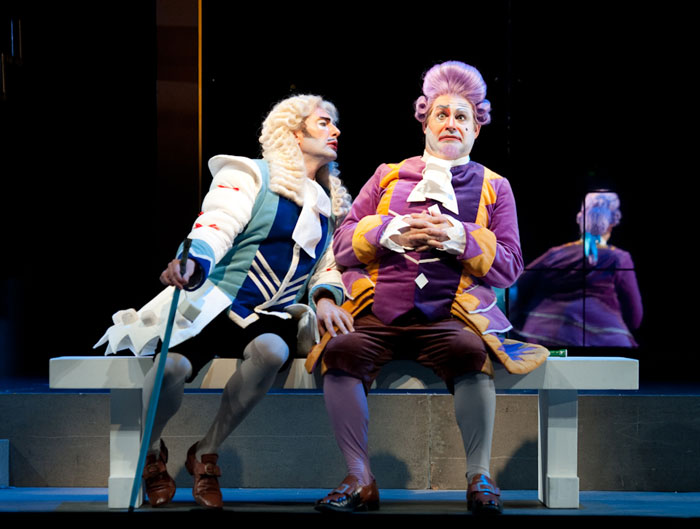
Soprano Sarah Coburn (pictured here in Seattle Opera's 2011 production of The Barber of Seville) stars as Marie on opening night of The Daughter of the Regiment.
© Rozarii Lynch
For our Golden Anniversary season, we’re presenting four operas that offer comedy and tragedy, reality and fantasy. We kick things off in October with Donizetti’s light-hearted romantic comedy Daughter of the Regiment, about an orphan—raised by a group of a French soldiers—who falls in love with a local villager and must overcome social expectations. Soprano Sarah Coburn reunites with tenor Lawrence Brownlee (they were last seen at Seattle Opera in 2011’s The Barber of Seville) as Marie and Tonio on opening night. For more info on the production and a more complete cast list (including bios, headshots, and audio clips), visit our Daughter of the Regiment webpage.


Seattle Opera’s 2004 production of Rigoletto.
© Rozarii Lynch
We begin 2014 with our second opera of the season: Verdi's Rigoletto, about a quest for revenge that leads to tragic results. Set in the 1930s, this production stars Italian baritone Marco Vratogna as Rigoletto, the court jester who fails to keep his beautiful daughter, Gilda, away from the womanizing Duke of Mantua. The opening night cast also stars soprano Davinia Rodríguez as the ill-fated Gilda, with tenor Francesco Demuro—who sings Rodolfo in next month’s La bohème—as the Duke. For more info, click here.


Soprano Marcy Stonikas (pictured here in Seattle Opera's Young Artists 2011 production of Don Giovanni) returns as Magda Sorel in The Consul.
© Rozarii Lynch
Quickly following Rigoletto is our February 2014 production of Menotti’s The Consul—a Seattle Opera premiere! We’re very excited to mount this Pulitzer Prize-winning thriller, which premiered in 1950. Following her leading turns as both Turandot and Fidelio’s Leonore this season, soprano Marcy Stonikas returns to the company as Magda Sorel, a wife and mother desperate to acquire a visa to flee a totalitarian nation. Baritone Michael Todd Simpson plays her husband, John, a political dissident on the run, and mezzo-soprano Lucille Beer—fresh off her company debut as Erda in the Ring—sings the role of his Mother. Also in The Consul is Sarah Larsen, who just wrapped up a run of performances as Tisbe in La Cenerentola. For more info, click here.

The Venice scene in Seattle Opera’s production of The Tales of Hoffmann.
© Rozarii Lynch
The season concludes in May with the return of Seattle Opera’s hit production of Offenbach’s Tales of Hoffmann. Stage Director Chris Alexander won the company’s Artist of the Year Award when this production premiered in 2005, and he returns for it in 2014. Tenor and audience favorite William Burden makes his role debut as the storytelling Hoffmann, who spins weird and wondrous yarns about romancing three beautiful women, all portrayed on opening night by French soprano Norah Amsellem. Mezzo-soprano Kate Lindsey, winner of Seattle Opera’s 2010 Artist of the Year Award for creating the title role in Amelia, sings her critically acclaimed Muse/Nicklausse. For more info, click here.

Single tickets for select performances won't go on sale until July, but you can secure your seats as part of a subscription package beginning February 1.

Friday, January 25, 2013

Meet our Singers: VALERIAN RUMINSKI, Don Magnifico

Tonight is our penultimate performance of La Cenerentola, and we’re sad to see the hilarious characters of this Rossini opera leave us. One of those characters is the pompous Don Magnifico, cruel stepfather to Cinderella, who is sung by both Patrick Carfizzi and Valerian Ruminski. We’ve already chatted with Patrick—and you can see him perform in tomorrow night’s closing performance—but now we get to know Valerian, who sings tonight. We talked to this bass about his work on stage, as well as behind the curtain: he runs his opera company in his hometown of Buffalo, NY. Read on for more, and visit http://www.seattleopera.org/Cinderella to grab tickets for our final performances!

Welcome back! It’s been a while since we’ve last seen you, hasn’t it?
Yes, about six years. I was here in 2006 for Così fan tutte, which was a Jonathan Miller production. That made it very special because Jonathan Miller is one of the all-around great directors and people on the planet. And being in a show with him directing is more like a Broadway theater acting experience, which is always a plus because it’s not your standard “park-and-bark” type of opera singing. Not all directors do that, of course, but Miller is a step above as far as taking us out of the opera element.

And you do some directing yourself, don’t you?
Only three years of Amahl and the Night Visitors. But I’ve produced eight productions for my company, Nickel City Opera, in Buffalo, NY.

Valerian Ruminski as Don Magnifico in Seattle Opera's current production of La Cenerentola.
Photo by Elise Bakketun

Yes, tell us more about your company! When did you begin Nickel City Opera?
Our first production was in 2009. I incorporated years before that, but I was only raising money to raise money, and not getting a production off the ground. But our relationship with the theater changed when they changed management. It’s a non-union, 1100-seat theater, and they wanted to some local company productions happening there, and they asked me if I’d like to start. So we did The Barber of Seville there in 2009, so we’re coming up on our fifth year in a row of doing one large opera every June. We’re doing Don Pasquale next June, and contemplating a fourth year of Amahl, which we do every Thanksgiving weekend.

We also did Il tabarro on a destroyer—U.S.S. The Sullivans—in the harbor, with full audience, costumes, lighting. It was at dusk and we had an orchestra on the stern of the boat and staged it all on the back of the boat, with supertitles on a boat behind it. We had about 400 or 500 people in the audience there, next to the Naval Park building. This was part of Buffalo’s effort to revitalize the waterfront, and I tried to get funding for it but I couldn’t, so I relied on box office. We took a hit on the box office, but we got a good review in the newspaper and a lot of kudos for trying.


(Above, the love scene from Nickel City Opera's Il tabarro)

What inspired you to begin an opera company?
Well, we haven’t had a company in Buffalo since 1997, and I wanted to give back to my town. There are a lot of reasons why, but I felt there was a call for it. And there were a lot of bad operas happening, a lot of bad productions with people scrambling around, and I knew I could put on stuff that was high caliber if I could find the resources. And I’ve slowly put together the pieces of the puzzle. We’ll see how long I can continue doing it, because I’m working on my own career as well.

Karin Mushegain (Cinderella) and Valerian Ruminski (Don Magnifico) in La Cenerentola.
Photo by Elise Bakketun

How much time does it take out of your schedule?
Well, I’ve been able to start putting it into a box a little more, because now I know what to expect every year. Things don’t change that much from year to year, I have found. And I find that the more professional people you employ, the smoother it goes. Plus, I hire people who have done the shows before, so I don’t need three or four weeks of staging. I have one week of staging in the hall, one week in the theater, and that’s it—two weeks. And it makes it fresh, because people are still a little on edge. [Laughs]

Let’s switch over to your career on stage. As a bass, you often have to play the role of the old man; how do you get into the right state of mind for those characters, when you don’t seem to be that old yourself?
Well, I’m getting there! I have more arthritis in my hands. Oh, but it’s not that difficult. I’ve been trying to act like an older guy ever since I was in my twenties, because I was getting hired to sing Verdi roles where I was supposed to play a character twenty years older. Now I’m at an age where I don’t have to act very much because I’m already in the middle age group, so I can sing these roles and I’m not trying to put anything on. This character of Don Magnifico is older than I am, so I’m playing him a little stodgier, a little more arthritic, I guess you’d say. [Laughs] But it’s not much of a jump to play old men.

Valerian Ruminski as Don Magnifico in La Cenerentola.
Photo by Elise Bakketun

What other buffo roles have you done?
I just did Don Pasquale at Hawaii Opera Theatre this past February, which was a real marathon. And then I did a concert of The Elixir of Love, as Dulcamara. Don Magnifico is my third large buffo role. I’m looking to do more of that. It’s good to make a living doing these roles, but I’m more of a bravura bass than a buffo. The basso cantantes, we’re sort of the chameleons of the bass category. A buffo can’t be a cantante; if you’re a natural buffo, you can’t sing bravura music, you can’t be a leading bass. You have to be a buffo. But if you’re a cantante, you can fake being a buffo. You can make the voice thicker and more bulbous.

Brett Polegato (Dandini) and Valerian Ruminski (Don Magnifico) in La Cenerentola.
Photo by Elise Bakketun

Do you have a favorite role in La Cenerentola?
Well, it’s my first time, so I’m discovering that. I don’t think I have one yet. But musically I enjoy the drinking scene with the chorusmen. It’s fun to sing and it’s sort of a blustery moment for Don Magnifico. He’s full-blown, and as close to his dream as he’s going to get. It’s stupid—he’s been made captain of the wine cellar, who cares?—but he thinks it’s the greatest thing in the world so he’s lording it over everybody. This is his big moment. From here on, he’s diminished because he finds out his daughters are not going to be married.

Tuesday, January 22, 2013

Listen to Speight Jenkins' Q&A from Saturday's LA CENERENTOLA

After every performance, General Director Speight Jenkins hosts a free Q&A session in the lecture hall at McCaw Hall. Listen to this live recording as Jenkins candidly answers the audience's questions after the Saturday, January 19 performance of "La Cenerentola." This Q&A session was also broadcast live on KING FM.

Sunday, January 20, 2013

Meet Our Singers: EDGARDO ROCHA, Ramiro

Today’s matinee performance of La Cenerentola features the US debut of Edgardo Rocha as Prince Ramiro. This exciting young Uruguayan tenor already has a great deal of experience with this opera, including an Italian television adaptation of La Cenerentola which was telecast around the world. He spoke to me about why La Cenerentola is a great first opera, about why he likes performing recitatives, and about the great lengths he has gone for voice lessons.

Welcome to Seattle Opera! Can you tell us more about your background, where you’re from, and how you got started in opera?
I was born in Uruguay, but I’ve been living in Italy for four years now. I study with tenor Salvatore Fisichella. Cenerentola was only the second opera I ever sang!

So what was the first opera?
Gianni di Parigi, by Donizetti, which we did in Martina Franca, with the Festival delle Valle d’Itria. Giacomo Sagripanti, the conductor who is making his US debut in Seattle with me now in this La Cenerentola, was the conductor of both my first two operas.

Small world! But have you sung in Uruguay yet?
Yes, little roles: Borsa in Rigoletto, Remendado in Carmen.

And then you moved to Italy, specifically to study voice and singing?
Yes. Actually, I live in Sicily, in Catania, and for my first lessons, which were in Florence, I went up by plane and came back home by bus.

That must have taken forever!
Yes, it’s a long trip, many hours. It worked out like that because it only takes two hours to fly there, so that could be planned more spontaneously.

Edgardo Rocha as Ramiro in La Cenerentola
Elise Bakketun, photo

What made you want to be an opera singer?
I studied music, piano, in my hometown of Rivera, near the border with Brazil. I started a chorus in my hometown, and I got to know the opera singers there. And with the chorus I started singing a bit, and then I got connected with our zarzuela group there, and sang with them. I was about 18 when I began studying singing.

You didn’t have anybody in your family, for example, who was a singer or a musician?
No, no, the family, no. They didn’t like it! In South America it’s very difficult to make a living in music, and my father said, “Oh, you can’t! You must study law or medicine. No music!” But I studied in secret.

Brett Polegato as Dandini and Edgardo Rocha as Ramiro in La Cenerentola
Elise Bakketun, photo

Oh, my! That can be hard to do, as a musician, because...you’re loud. It’s hard to keep it a secret from someone who lives in the same house, when you have to practice.
I even sometimes told my father, “I’m going to sleep over at my friend’s house” when I really was going to the capitol, 500 kilometers away...

That’s how you got used to taking buses all night long!
...to take lessons in Montevideo. All a secret, only my grandmother knew. She gave me the money!

I hope someone will make a movie of this—what a great drama!
And a year later I won a monetary prize, which made it seem more legitimate to my father. It’s difficult, because although there’s an old tradition of opera in Uruguay, most normal people don’t know much about it.

In Argentina there’s one of the most important opera houses in the world, the Teatro Colón...
And in Montevideo, the Teatro Solis, that’s a very good theater with a long tradition. Although they’ve been having money trouble recently...there are only two operas this season, and the tickets are very expensive.

Edgardo Rocha as Ramiro and Karin Mushegain as Cenerentola in La Cenerentola
Elise Bakketun, photo

Now, let’s talk about La Cenerentola a little bit. What is your favorite moment in this opera?
Only one?!

Okay, what’s your favorite NOTE in La Cenerentola?
What!?

Because we were talking to René Barbera, who shares your role of Ramiro, and he mentioned how much he likes this one high B—
“Lo giuro, lo GIU-ro!”

--right, that one, it comes out of nowhere and it’s just amazing.
Yes, that is fantastic. It’s so affirmative, so strong. “I am the prince. STOP IT!” More so, even, than the aria, where I sing five high Cs. I think “lo giuro,” with this B, is probably the best.

Is that one of those high notes where you get to hold it for a long time?
Yes, Rossini wrote a fermata. So the conductor has to stop there!

What do you think the moral of Cenerentola is?
I think Cenerentola is a very good first opera because, besides its wonderful music, there are these great characters—real people, the simple, honest young Cenerentola, the jealousy and envy of the sisters, the ambitious step-father. All the important lessons of life are here in this opera, which Rossini gave the second name of La bontà in trionfo, Goodness Triumphant. That a rich person like Ramiro finds this simple girl, without any money—this is important to communicate to our audience.

Does Ramiro learn anything from Cenerentola?
Ramiro is much the same as Cenerentola—he is a very simple person. He has the same values that she does. But because he is prince, he’s in a difficult situation—it’s hard for him to demonstrate his values, he can’t choose. I think meeting Cenerentola confirms his own feelings. His father ordered him to get married, but he’s a young man, and he’s upset when we first meet him because he doesn’t want a loveless marriage. But he doesn’t yet know Cenerentola.

That’s right, he says that, and then poof! Two seconds later he’s singing a love duet with Cenerentola. Now, we saw the neatest trailer online for this television Cenerentola you did directed by Andrea Andermann, Cenerentola una favola in diretta.
Yes, this was a cut version of La Cenerentola—no recitatives, and they cut the Dandini/Don Magnifico buffo duet. Honestly, it was difficult for us, the singers, to do it without recitatives, because the soul of the opera is in the recitatives. That’s where you understand clearly what happens. In the aria you can say “I love you, I miss you,” but in the recitative that’s where you’re the real person—without orchestra, alone, just speaking, and this is where the story is.

How was it filmed?
We were on location, in different places. The orchestra was in an auditorium, and we were in the locations—Don Magnifico’s house, Ramiro’s castle—working with an Assistant Conductor and with the sound piped in.

Sounds complicated!
It was complicated. My aria was filmed in a huge salon, and the reverb from the speakers of the orchestra was way too loud. But I think it was a very good idea.

It looked like they used a slipper, instead of La Cenerentola’s bracelet.
Yes, Andermann wanted it to be closer to the Disney Cenerentola. But it was a very good production. We had a great feeling among the cast. It was my first time on television—I had to readjust when I got back to the theater, where it’s not quite so intimate!

Edgardo Rocha as Ramiro in La Cenerentola
Elise Bakketun, photo

You are very young, so what are some roles you’re hoping to sing in the next few years, or other houses where you want to perform?
My repertory now is Rossini, Mozart, and three or four of the Donizetti buffo operas: I like Don Pasquale, that’s a very good role for me. And Gianni di Parigi. I’ll be singing a lot of Rossini: Barbiere in Zurich, La donna del lago at Covent Garden.

Are you going to sing in Spanish? Any more zarzuelas on the horizon?
I don’t know, I love singing in Italian. For zarzuela you need a very good lyric tenor—they have to be very dramatic.

Any Bellini?
I debut La sonnambula in 2015 in Frankfurt.

What about Arturo in I puritani?
This is my dream! But I think you must arrive with not just technical security but maturity onstage. It’s much like Aida, the struggle between his romance and his patriotic obligations. You’re not in the second act, yet you have a very long third act. This can be dangerous!

Friday, January 18, 2013

Search for Cinderella: Day 4 Wrap-Up

Ooh, today's final hunt had a couple tricky clues thrown in--so extra big congratulations to grand-prize winner Jaci D., who won a pair of tickets to each of our remaining 2012/13 operas! She figured it out in a mere 19 minutes, and Ed R. came in 25 minutes later for our runner-up prize of "Viva Verdi!" tickets. And we had so many people playing this round, we gave out one bonus runner-up prize, to Joanna L.! Thanks to everyone for playing; we hope you had as much fun as we did. And, as in days past, we break down the clues that got them to the finish line...

January 18 Clues

At 10 a.m. on Facebook, we uploaded a very special photo album (and we also tweeted the link for on Twitter). That album was our very first clue:


(Click photo to see full size)

It had several pictures (with accompanying captions) that needed to be unscrambled. If you had figured out the correct order, you would've read the instruction to "find full photo seattle opera dotorg slash suorangelica." More elegantly stated, that meant you should've gone to seattleopera.org/suorangelica to find the full-size version of this particular image. Had you navigated to our photo player on that webpage, you would have come across this image, which, unlike our FB version, includes Rosalind Plowright's head:


(Click photo to see full size)

The caption for this image read "blog search: 2012/13 season," which should have led you to this very Seattle Opera Blog, where a search would have yielded these results:


(Click photo to see full size)

The first link is to our original announcement of the 2012/13 season, and that's where you should have gone.


(Click photo to see full size)

Spread throughout that post was a series of zeroes and ones, which could only mean one thing: binary code! And for those folks not fluent in binary code, there are many online translators available for free. Using one of those would have given you this translation:


(Click photo to see full size)

Translated, 01111001 01101111 01110101 01110100 01110101 01100010 01100101 00100000 01110100 01101000 01101001 01110010 01100100 00100000 01101111 01110000 01100101 01110010 01100001 00100000 01110100 01110010 01100001 01101001 01101100 01100101 01110010 is a very long way of saying: "youtube third opera trailer." And from reading that previous blog post, you would have known our third opera of the season is La Cenerentola (also known as Cinderella). And, by the way, we still have five more performances of this fantastic opera left...


(Click photo to see full size)

So, had you gone to YouTube and viewed the Cinderella trailer, you would have noticed, just after the 1:40 mark, a speech bubble appearing over Don Ramiro's head. "Who will sing me this Sunday?"

The answer is tenor Edgardo Rocha, and this is where it could have gotten tricky. We didn't tell you WHERE, exactly, to go next with this information--although we hinted at it in the video caption, where we wrote, "For tickets and more information, including cast lists, visit: http://www.seattleopera.org/cinderella." Or, you might have discovered that Edgardo Rocha was the answer by navigating to our cast page in the first place. In which case, you might have clicked on his bio...


(Click photo to see full size)

His bio seemed to be fairly normal--except for this very odd line: "Seattle Opera Debut Turandot, Turandot ('67)"

What's so weird about that? Well, Edgardo is a very young man, who would never have been able to make his debut in 1967. Plus, Turandot? Edgardo is very much not a woman or a soprano, so that should've rang some bells. Also, this production of Cinderella happens to be his company (and U.S.) debut. The "'67" in that line of text was hyperlinked and clicking on it would have taken you right back to our Facebook page.


(Click photo to see full size)

From there, you should have navigated to 1967 on our Timeline, where we have some photos posted of our very first Turandot production. Clicking through those would have taken you to this particular photo, with that year's actual Turandot, Licia Vallon, and a special caption.


(Click photo to see full size)

That caption read: "Of course, the young Edgardo Rocha couldn’t have actually made his debut in 1967 or as the very soprano Turandot—but it got you here! TURANDOT opened the 2012/13 season; which opera followed it, and what did our audiences think?"

It just so happens we keep a tab on our production pages for "Audience Reviews," where we encourage opera-goers to leave their thoughts. You might have already known that, in which case it was easy to find the page for Fidelio. Or you might have Googled something like "Seattle Opera Fidelio audience reviews," in which case you would have also been pointed in that direction.


(Click photo to see full size)

Once there, you would have seen the following comment: "First Turandot, then Fidelio, now Cinderella, with Bohème and Voix Humaine/Suor Angelica upcoming. Catch the remainder of the 2012/13 season—if you’re fast enough: SeattleOpera2013@gmail.com."

And that was that! Thanks to EVERYONE who played, and make sure to like us on Facebook and follow us on Twitter to be the first to hear about future opportunities and giveaways.

P.S. If you want to read how the first three hunts were solved, visit: Day 1, Day 2, Day 3.

Wednesday, January 16, 2013

Meet Our Artists: GIACOMO SAGRIPANTI, Conductor

Our production of La Cenerentola introduces the exciting talent of Giacomo Sagripanti to US audiences. Sagripanti made a terrific first impression this weekend—critics are praising “the sleekly polished playing” [Music Web International] he draws from the orchestra, and how he “slackens the pace judiciously, giving room for lovestruck arias to blossom” [The SunBreak]. Seattle Opera expects great things from this young Italian maestro. I chatted with him before Sunday’s performance about his background, the recitatives he’s accompanying at the fortepiano, and his choice NOT to use a baton to conduct this opera.

Welcome to Seattle Opera, Maestro! Could you tell us where you are from, and how you began with music?
Yes, I was born in Abruzzo, inland in the center of Italy. But My parents come from a town near Ancona and Pesaro, the city where Rossini was born. And today I live in Montegiorgio, a little town on the Adriatic Sea about an hour away from Pesaro. I started with piano, I studied piano and composition, and studied conducting later, in Pesaro and Pescara. My teachers for the Italian opera conducting tradition were Donato Renzetti, Nicola Luisotti, Renato Palumbo, Bruno Bartoletti, Piero Bellugi, Antonello Allemandi and others. For the symphonic repertoire I studied with Gianandrea Noseda, Vladimir Ponkin and Colin Metters.

Wow! And you were telling me about the time you spent in Moscow studying at the Moscow Conservatory. Have you conducted any Russian operas?
Not yet; I’ve conducted Russian symphonic music. Maybe one day, the operas! I conducted Hänsel und Gretel, which is an almost-Wagnerian opera, in Lübeck; that was a great experience. I love Wagner and the big German tradition...almost as much as Seattle loves it!

What is the biggest challenge in conducting La Cenerentola?
In this type of opera the biggest challenge is usually the ensemble that brings the first act to a close. In La Cenerentola, when we hear the theme from the overture [sings manic tune of finale]. It’s always this way in opera buffa, whether it’s Italiana or Barbiere or Mozart's Nozze di Figaro finale. It has to be precise.

Let me ask you about the recitatives in La Cenerentola.
Oh, yes, and there are a couple of important things to say here. First of all, these secco recitatives in Rossini’s operas are NOT by Rossini.

Oh, that’s right, I was reading that somewhere, the composer’s name was Agolini?
Yes, a colleague of Rossini. Rossini never had enough time, so he had other people write his recitatives. Agolini also wrote a chorus that goes in at the beginning of the second act—although, as is normal with productions of La Cenerentola, we don’t do it here because it is not by Rossini. And also the Clorinda aria and the first version of the Alidoro aria [“Vasto teatro è il mondo”]. Secondly, in Rossini’s period, it was typical to do recitatives with fortepiano, because the harpsichord was out of fashion.

So...Paisiello, for instance, who wrote The Barber of Seville a generation before Rossini, in the 1780s...
...would have been with harpsichord, yes. But at the time of Rossini the fortepiano was the prince of keyboard instruments.

Giacomo Sagripanti accompanies Seattle Opera's La Cenerentola recitatives on a fortepiano, a replica of an Anton Walter instrument (Vienna, 1795) built by Rodney Regier of Freeport, ME and owned by Tamara Friedman and George Bozarth of Seattle
Elise Bakketun, photo

The iPod 5 of its day, as it were.
Exactly! And it’s typical of this period also to use the cello in all the recitatives. The cello is there to amplify the character of the recitativos. It gives the recitative more expression and connection with the characters, more of the dynamic on the stage.

I love the moment in the recitative here, when Don Magnifico, having heard about the prince’s ball, sings, “Io cado in svenimento!” [I shall swoon!] and the cello...
[sings cello line at this point, a glissando sliding down a string]

Yes, the way the cello slides down. Was that your idea?
Yes. The basic idea is, musically, to remind and explain what is happening onstage, the sense of the recitatives. The cello not only has to match the left hand of the pianist, the bass line, but also to improvise, like in this case. Speaking of the bass, in Rossini’s period you would actually have the double bass hitting those low notes, with the cello providing harmony. But today this is not possible, because it becomes too heavy and slow for us. The way we listen to music has changed; everything is faster today,and we need to follow the actual reaction times of the audience and of the music.

This is the first time at Seattle Opera we’ve used cello in a recitative.
Yes, I asked to do it this way, and I was very lucky because Roberta Downey, our principal cellist, is a wonderful performer and was open to this idea. We’ve had a great time working together, and with the singers—had to get it all organized in only two rehearsals!

I’ve noticed you don’t use a baton when you conduct La Cenerentola. Is that because your hands are going back and forth from the keyboard to their conducting position?
I use baton for the overture. Yes, it’s easier, since I have to play, not to use one; but it was always like this, in the period. The baton was born from the bow of the first violin, originally. It’s all relative. I can get away with not using a baton, in this repertoire, because the orchestra is small—we have no timpani or percussion, trombone is the only "big" instrument. The sound you can get, particularly from a wonderful modern orchestra like this one, is morbido, soft. There are no big vertical moments. The principal function of a baton is to give a clear tempo; but with this kind of music, it is possible just to use your hands. You can communicate more about the fraseggio, the sense of phrasing, this way. I’ve conducted La Cenerentola several times before, and so I know it very well and find this is better. Also with the prelude to La traviata, I like to conduct that without a baton, because you can transmit a lot of ideas more clearly with the hand—it’s more legato, there’s nothing between you and the orchestra. Of course it isn’t possible for Puccini, with the big orchestra and all the tempo changes. It also depends a bit on what’s onstage; here we have a small chorus, but if you were conducting Nabucco, the baton helps all those people see what you’re doing.

Maestro Sagripanti uses a baton to conduct Seattle Opera's orchestra in the La Cenerentola overture
Elise Bakketun, photo

This question may be unfair—at this point you’ve only had one performance! But can you comment on the differences between how an American audience reacts, at an opera buffa, to how an Italian audience would react?
The reaction here is sometimes very big, lots of laughs. This is logical, of course, and the stage director and the production are aiming at this response from the public. This might happen in Germany, too; but in Italy there’s a different tradition, with our idea of listening to bel canto. Rossini is one of the major bel canto composers, and for an Italian audience, listening to bel canto, what’s happening onstage in some passages is not as important.

They’re listening.
Yes. This is not better or worse, it’s just different, because of the history. But the most important thing is that the public enjoy it! Always!

Search for Cinderella: Day 3 Wrap-Up

This morning was our penultimate digital hunt, and it should've been called the "Search for Mimì" rather than "Search for Cinderella," because our prize was a pair of tickets to next month's production of La bohème, along with dinner for two at Ten Mercer and a night's stay at The Maxwell Hotel. As we've done with the two other hunts, we'll break this one down and show you how the winner got to the end of today's trail of clues. Congratulations to Dale Abersold for winning our grand prize and to Greg Barnes for claiming the runner-up prize of two tickets to the Young Artists Program's "Viva Verdi!" concert on April 6!

January 16 Clues

At 10 a.m. on Facebook and Twitter, we announced today's prize and shared a link to our La bohème production page. On that page was our very first clue:


(Click photo to see full size)

The final blurb of text on the page read "Tweet Tweet" and provided a timestamp, which was a clue toward our Twitter feed.


(Click photo to see full size)

Sure enough, there was an update we'd tweeted yesterday (15 JAN 13) at 2:27 PM. That link was to bass Arthur Woodley's Q&A on this here blog. This particular page was chosen, by the way, because Woodley stays in Seattle following Cinderella and will also perform in La bohème!

Once on his blog, you may have noticed a suspiciously large gap in the text. If you had highlighted that area, you would have been able to read the hidden message.


(Click photo to see full size)

That message read "seattleopera.org/ PLUS ArthurWoodley’sMostRecentSeattleOperaProductionPriorToThisSeason." That was supposed to guide you to a URL, and some research would've told you that prior to 2012/13, Arthur Woodley sang in 2010's Lucia di Lammermoor. So, going to seattleopera.org/luciadilammermoor redirected you to Stage Director Tomer Zvulun's bio on our website.


(Click photo to see full size)

As the clue read, Zvulun worked with Woodley in Lucia di Lammermoor, and both will return for La bohème. But that production of Lucia has one other link to Bohème, and the word "link" was, appropriately enough, hyperlinked to take you to the cast page for Lucia.


(Click photo to see full size)

Had you compared that list of artists to the one for Bohème, you would have noted that there's only one commonality, besides Zvulun and Woodley. And that's Lighting Designer Robert Wierzel.


(Click photo to see full size)

Clicking on Wierzel's name takes you to his bio, which had a bonus image embedded. That was a screen cap of our 2007 Bohème trailer on YouTube.


(Click photo to see full size)

Everything would have seemed normal on this page--unless you had clicked "Show more." Then you would have been presented with a series of dots and dashes. That's Morse Code, and you didn't need to be fluent to translate it; a visit to any search engine would yield tons of Morse Code-to-English translators.


(Click photo to see full size)

The translation? "SEATTLE OPERA'S CARMEN ON FACEBOOK." While this could've been taken as a nudge toward some Carmen-related content on our Facebook page, it was actually a lead to our popular graphic "If Carmen and her friends were on Facebook...". And at the bottom of the page was a brand new comment...


(Click photo to see full size)

Hmm. Figaro's wedding photos? That could only refer to The Marriage of Figaro, which we last produced in 2009. And since we mentioned Facebook...


(Click photo to see full size)

A scouring of our Facebook page (either by scrolling through our timeline to 2009, or by scrolling through our list of photo albums) would have led you to this photo album from that Marriage of Figaro production. And one of its five photos had a special caption...


(Click photo to see full size)

That particular photo shows Elizabeth Caballero, who was Susanna in 2009, and returns as Mimì in Bohème. And the caption pointed our victors toward today's special e-mail address, AllAboutMimi2013@gmail.com, which they e-mailed to claim their prizes!

That wraps up today's hunt, but there's still one more to go. Make sure to come back this Friday for one final grand prize, as well as a runner-up prize of "Viva Verdi!" tickets.

Monday, January 14, 2013

Search for Cinderella: Day 2 Wrap-Up

We hope you joined us this morning for our second hunt in our Search for Cinderella! We posted a recap of last Friday's trail of clues here, and once again we'll break down the path our winner had to take to claim today's prize of a four-pack of tickets to this Sunday's Family Day matinee performance of Cinderella. Today was more challenging than Friday's kick-off hunt, which lasted only about 5 minutes before the prize was claimed. Today, it took about 50 minutes--10 times as long! Congratulations to Chloe V. who made it to the finish line first. Here's how she did it...

January 14 Clues

At 10 a.m. on Facebook and Twitter, we announced today's prize and shared this image:


(Click photo to see full size)

That's a screen-cap of this very blog, with the words "YOUTH CHORUS" typed into the search box, to the right. If you traveled to the Seattle Opera Blog and searched for that phrase, you'd come across these options:


(Click photo to see full size)

If you'd clicked on the first choice and watched the Youth Chorus video from Carmen, you'd have noticed this speech bubble pop up at the :45-mark...


(Click photo to see full size)

Next, you would have needed to head to Facebook--specifically, the Seattle Opera Facebook page. If you had scrolled through our many photo albums, you would have found one titled "Magic Flute Family Day."


(Click photo to see full size)

Within that album are several photos of Parlin Shields as the Magic Flute emu, but one of those photos had a special caption:


(Click photo to see full size)

This clue was a little difficult, but it hinted that you should try searching Google for "Heron and the Salmon Girl," which is the name our first Our Earth opera. You would have been given a few different options, but only one had "Heron and the Salmon Girl" prominently featured in its title (the second link in the photo below).


(Click photo to see full size)

That link would send you to the Heron and the Salmon Girl production page on our website, which has a special subhead and message just for those playing the Search for Cinderella:


(Click photo to see full size)

That message was written backwards, but if you flipped it around read "The mezzo's clip on the Seattle Opera SoundCloud" and was hyperlinked to take you to the Seattle Times' photo gallery of our recent Cinderella open house at McCaw Hall. Then you would have needed to spot the mezzo-soprano amongst the images:


(Click photo to see full size)

The final photo was of Karin Mushegain, who sings Cinderella in our Sunday/Friday performances. The earlier two-part clue indicated you needed to find Karin's clip on the Seattle Opera SoundCloud page, where we upload lots of great clips from our performances. Had you navigated to that page, you would have noticed that the second clip is of Karin--but it wasn't a musical excerpt.


(Click photo to see full size)

That audio clip was actually a special message from Karin to you, congratulating you for (nearly) making it to the end of the hunt. She also gave you the super-secret address to e-mail--DancingRats2013@gmail.com--in order to claim your free tickets!

Phew, that was a tough one, but we hope the winners enjoy their prizes, and that everyone who participated had fun on the trail. If you didn't win this time, come back on Wednesday and Friday at 10 a.m. when we do our final two rounds of the Search for Cinderella! Those next prizes will remain top secret 'til each hunt begins, but trust us--they're pretty awesome!

Sunday, January 13, 2013

Meet Our Singers: KARIN MUSHEGAIN, Cenerentola

Karin Mushegain (left, photo by Elise Bakketun) sang Cinderella’s famous opera-concluding aria in audition for Speight Jenkins, Seattle Opera’s General Director, in December 2012 in New York. It went well; but she never expected she’d be flying to Seattle a week later to make her Seattle Opera debut in her favorite role. An unexpected cancellation, just a day or two before rehearsals were to begin, had left Seattle Opera without a mezzo soprano for three of the January performances of this Rossini comedy. Luckily for all concerned, Ms. Mushegain was able to re-arrange her schedule, join Seattle Opera for the production, and share her gifts and talents with our audience. She makes her debut this afternoon. I spoke with her a few weeks ago about coloratura technique, her summer in France, and how Cinderella might be avenged on an unsupportive childhood music teacher.

Welcome to Seattle Opera! First things first, would you pronounce your name for us?
Yes, it’s kah-REEN moo-SHAY-ghee-un.

It’s an Armenian name?
Yes, it’s Armenian, and my last name is pronounced as if it were “-ian,” but it’s spelled differently because when my great-grandfather and his three brothers emigrated here, they each got a different spelling and each kept it.

Wow.
‘Cause they didn’t know how to tell them how to spell it. So they kept it. But I’ve had people call opera companies, all offended, and say, “You spelled her name wrong!” But no, that’s how I spell it.

Okay, so tell us a little about your background, where you’re from, and how you got started in opera?
I was born in raised in Pasadena, California, and like a lot of singers always sang when I was little. I got kicked out of piano lessons as a little kid because I wanted to sing the songs, instead of play them. I started taking voice lessons very young, when I was 11, because my music teacher at school had made fun of my voice, in front of the whole class, and I had stopped singing. So my mom put me in voice lessons, so I would start singing again!

What happened to the music teacher?
She still works there, I think. My family used to send her letters...you know, every time I was in a new opera, they’d send the program there!

Cenerentola (Karin Mushegain) gets a ride to the prince's ball
Elise Bakketun, photo

Send it along to the higher-ups, get her fired.
No, nobody wanted bad karma, they just wanted to make her feel bad. Armenian family, you know, we like to make people feel guilty. [laughs] So yes, later I went to Northwestern University, and studied both vocal performance and musical theater there. I moved to New York on September 1, 2001, and ten days later everything changed, and Broadway closed down, so then I went back to school, to UCLA, and started refocusing on opera.

At Northwestern you had been more focused on musical theater...
Both, but their musical theater program is so phenomenal, studying acting and dancing every single day. But I finished the opera program at UCLA, and then went to Pittsburgh to be a Young Artist.

Karin Mushegain at La Cenerentola rehearsal
Alan Alabastro, photo

Now, you made your European debut this last summer.
Yes, in France in this lovely little company called Lyrique-en-mer, on a tiny little island, Belle-Isle, in the Bay of Biscay. The nearest part of France is Brittany. All farms, all rural, and it was nice because no one spoke English. You really had to immerse yourself in French and French culture, which was fun.

Did you speak French very well before you got there?
I speak French poorly. I did Rosetta Stone before I went there, to prepare myself, and it’s amazing, it really helps. I’m very thankful I did it.

What were you singing?
The role I’m doing here, Angelina [aka Cenerentola] in La Cenerentola.

Now, it looks like you’ve been singing a fair amount of Tisbes, too.
I have, I sang the wicked mezzo sister with Glimmerglass and with Florida Grand. Altogether I’ve done 23 or 24 performances of this opera.

Did you learn Cenerentola’s arias while you were singing Tisbe?
It definitely helped, it helped hearing it all the time. And at Glimmerglass I was covering Cenerentola, so I really learned it then. The cover cast had a performance onstage, with orchestra and costumes and sets and everything.

Which character is more fun to do?
Good question. Tisbe is more fun to play, but Cenerentola is more fun to sing. And she’s more interesting, she has a bigger journey. Tisbe doesn’t really change over the course of the opera...she’s pretty stagnant.

But it seems like such a fun role to do, because she’s such a twit!
She’s so fun, and I also love having a partner onstage, that’s a blast. It’s like they’re twins, you always have your buddy there.

But not as much fun to sing, since you don’t have quite so much of the amazing coloratura that Cenerentola gets to do.
This is my dream role, in life, this is what my voice does, what I enjoy doing, this music is delicate and precious but it’s also strong...

The Prince (Edgardo Rocha) discovers the mysterious beauty's bracelet on the arm of the lovely serving-girl Cenerentola (Karin Mushegain)
Elise Bakketun, photo

Was it hard to get it into your voice, the first time?
I really think you’re either born to sing coloratura, or you’re born to sing legato, and you have to learn to do the other. And my voice naturally does coloratura. But yes, the thing that’s tricky about this is there are so many runs, and they’re all just a little different. You have to have a road map. I do all my runs by number: 1, 2, 3, 4, 1, 2, 3, 4 [demonstrates singing a coloratura run]. My whole score is all numbers, written out, and I’m thinking those numbers as I’m singing it. You may hear, “Vengo, vengo, ve-e-e-e-e-e-e-e-e-ngo” but I’m thinking “1-2-3-4, 1-2-3-4, 1...” in my head.

What an interesting technique! Now did your teacher...
Yes, my voice teacher, Juliana Gondek, taught me that. “You obviously know how to sing coloratura,” she said, “but it’s messy at times, and this is how you clean it up.” And you can’t mess it up when you’re thinking the numbers. That’s how my brain works: I like to organize it and have a map.

That’s brilliant, I want to see the Excel spreadsheet with the database of all the high notes you’re going to sing in this opera! [laughs] Now, you mention how Cenerentola grows over the course of this opera...
It’s easy to get used to a bad situation. When you’re a servant, doing chores all day, or being picked on, and then there’s this moment when she gets woken up—she gets invited to the ball, but then it gets taken away from her. But this is something new, something that hasn’t happened to her before. She reaches her peak of frustration, and we get to see that. In the pre-story in my head, she hasn’t yet reached that peak. To me she has accepted her existence, but here she reaches the boiling-point, she is lost in despair, and that’s when Alidoro comes in, and she gets this sense of hope again. You see her deal with that, and then in the Act 1 finale she appears at the pinnacle of her strength: she’s in disguise, she can be whoever she wants—

She’s so good at it, she’s the belle at the ball par excellence, as if she were born to it...
She has been. That’s why I love Joan’s direction, he wants her very calm and in control at every moment.

It's love at first sight for Ramiro (Edgardo Rocha) and Cenerentola (Karin Mushegain)
Elise Bakketun, photo

Even when she first meets Ramiro, and gets all flustered?
Well, he allows that, but he’s constantly reminding me that I need to be calmer and more collected. Which is interesting—I’ve played her a bit more frantic, because I think that’s how I am, internally, and so it’s been a nice way to rediscover her, as a calmer, tranquil person.

And even in that love-at-first-sight duet, which shakes up her well-ordered world, it’s still very controlled, very elegant, very Rossini-classical. And then in the second act, you get even stronger, even more control, when you give him the bracelet and say: “Okay, your turn now.”
Yes, and with her family. I love how she teases them when they come back from the ball: “Oh, why did you have such a bad night?” I love it when she’s ballsy and gusty. But she never loses herself. At the end, when she forgives her family and tells the prince, “If you love me, this is the time not to stoop to their level, but to let goodness triumph.” She’s herself the whole time, but she increases in strength over the course of the opera.

And it’s Alidoro who makes all that possible for her.
I think so. She’s never had anyone 100% on her side before. This is someone who has shown up for her, just for her.

What’s your favorite moment in this opera?
Ensemble-wise, my favorite part is the quartet-quintet at the end of the first scene. I just think there’s a little of everything there. There’s the excitement of Ramiro being there, and looking at him, there’s the frustration of her father, not letting her go to the party, the vulnerability when she’s thinking “Am I just always going to be the cinder-girl?”

[Hums plaintive tune to “Ah, sempre fra le cenere, sempre dovrà restar?” 0:46 in the above excerpt]
I mean, does that not get to you? Is that not the prettiest line in the whole opera?

Cenerentola (Karin Mushegain) begs her stepfather Don Magnifico (Valerian Ruminski) to take her to the ball
Elise Bakketun, photo

It’s a bit like “Una furtiva lagrima,” the pretty tenor aria in Elixir of Love. Something dark in the midst of this very, very happy, bright, major-key piece.
Yeah, and it’s one of those wonderful frozen bel canto moments, where nothing else is happening—and those musical phrases wrap up exactly what she’s feeling every day.

Well, we look forward to hearing you sing it toi this afternoon!