General Director Speight Jenkins reveals how he assembled the Carmen cast and who he’s thrilled to see in their American debut. Plus, our leading Carmen (Anita Rachvelishvili) comes to Seattle after bringing down the La Scala house, and this video features an excerpt from her ravishing performance.
Learn more about Carmen on the Seattle Opera website.
BUY TICKETS HERE
Thursday, August 25, 2011


Friday, August 19, 2011
Learning the Ropes of Technical Theater
Earlier this month, Seattle Opera’s Education Department partnered with the Western Washington Theatrical Training Trust for a very special technical theater workshop. The workshop, hosted at Seattle Repertory Theater from August 2-4, was geared toward teaching high school students and teachers skills they could go on to use in their own productions. Education Intern Olivia Biddle was there, and she shares the following recap of this exciting event.
Day 1: Rigging and Scenery
On the first day of the workshop, participants checked out some of the newest technology in stagecraft, while learning how to use the equipment they’d find back in their own high school scene shops. Our pros shared inexpensive tricks of the trade that can be used for set building, and cut a set piece that the participants then took to the paint shop, where they learned practical tips to use back at their schools. Next, the group got onstage and learned about safety when using the fly system—literally “learning the ropes” with the rail (technology as old as sailing, which helps quickly and easily fly set pieces, lights, and curtains in and out).

Day 2: Lighting and Video Projection
The next day, the group learned to use lighting equipment: the basics of how electrics work, how to hang a light, and how to mix colors to get desired effects. Lighting offers a special kind of theatrical magic, but the use of projection is also becoming much more common and offering a magic all its own. We explored how projections enhanced the production of Sunday in the Park with George at the 5th Avenue Theatre in 2009; the set images were all projected rather than painted. High schools, of course, are not as well-equipped as a professional theater the size of the 5th Avenue Theatre or Seattle Repertory, but the group learned how to creatively use what they have on hand, such as using mirrors and angles to fill a tight set piece with projections.

Day 3: Hair, Makeup, Costumes, and Sound
On the final day of the workshop, participants learned how to manage a one-minute quick-change, turn a high school student into Grandfather Abernathy, and make the Wizard of Oz sound bigger than life. They also got tips on organizing their costume stock, different techniques for applying make-up, and yet more techniques for getting makeup stains out of costumes. The group also learned how to use a variety of different sounds, set frequencies, and keep a mic pack from shorting out when it is strapped to an actor.
Seattle Opera is excited to partner with other local organizations to offer programs that help local schools, the community, and individuals--and it is exciting to know that through programs such as this one, the next wave of great theater crew is being trained today!
-- Olivia Biddle
Day 1: Rigging and Scenery
On the first day of the workshop, participants checked out some of the newest technology in stagecraft, while learning how to use the equipment they’d find back in their own high school scene shops. Our pros shared inexpensive tricks of the trade that can be used for set building, and cut a set piece that the participants then took to the paint shop, where they learned practical tips to use back at their schools. Next, the group got onstage and learned about safety when using the fly system—literally “learning the ropes” with the rail (technology as old as sailing, which helps quickly and easily fly set pieces, lights, and curtains in and out).

Photo taken from video by Bill Mohn
Day 2: Lighting and Video Projection
The next day, the group learned to use lighting equipment: the basics of how electrics work, how to hang a light, and how to mix colors to get desired effects. Lighting offers a special kind of theatrical magic, but the use of projection is also becoming much more common and offering a magic all its own. We explored how projections enhanced the production of Sunday in the Park with George at the 5th Avenue Theatre in 2009; the set images were all projected rather than painted. High schools, of course, are not as well-equipped as a professional theater the size of the 5th Avenue Theatre or Seattle Repertory, but the group learned how to creatively use what they have on hand, such as using mirrors and angles to fill a tight set piece with projections.

Photo taken from video by Bill Mohn
Day 3: Hair, Makeup, Costumes, and Sound
On the final day of the workshop, participants learned how to manage a one-minute quick-change, turn a high school student into Grandfather Abernathy, and make the Wizard of Oz sound bigger than life. They also got tips on organizing their costume stock, different techniques for applying make-up, and yet more techniques for getting makeup stains out of costumes. The group also learned how to use a variety of different sounds, set frequencies, and keep a mic pack from shorting out when it is strapped to an actor.
Seattle Opera is excited to partner with other local organizations to offer programs that help local schools, the community, and individuals--and it is exciting to know that through programs such as this one, the next wave of great theater crew is being trained today!
-- Olivia Biddle
Tuesday, August 16, 2011
Seattle Opera's 2010/2011 Artists of the Year
Last week at Seattle Opera’s Annual Meeting, Speight Jenkins announced the winners of the company's 2010/2011 Artists of the Year awards: soprano Aleksandra Kurzak and costume designer Zandra Rhodes. Both of these artists made their Seattle Opera debuts last season, and both made memorable impacts on their respective productions.
 As Lucia in the October 2010 production of Lucia di Lammermoor (see left; photo by Rozarii Lynch), Polish soprano Kurzak blew audiences away and earned rave reviews from critics, who called her “a determined young woman of considerable talent,” and said she “set the theater alight both vocally and dramatically.”
Said Jenkins: "Aleksandra Kurzak gave us one of the great Lucias of my life, vocally and dramatically. She suggested Lucia's condition and both acted and sang her madness with unforgettable panache."
If you missed Kurzak as Lucia, check out the trailer for last season’s production to get a glimpse of her in action:
 Our other Artist of the Year recipient, Zandra Rhodes (pictured here at Neiman Marcus in Bellevue; photo by Alan Alabastro), made her company debut as costume designer for the season-closing production of The Magic Flute in May.
Rhodes is a noted fashion designer whose creations have been flaunted by royalty, Hollywood celebrities, and Vogue, and who only recently began designing for the stage. Her incomparable style, which makes use of vivid colors and textures, has been stunningly upheld in her transition from couture to costumes.
"[She] opened her imagination to create the most extraordinarily fanciful costumes for The Magic Flute," said Jenkins. "Their greatest virtue was that no matter how exotic or colorful, they never overwhelmed the musical and dramatic realization of the different characters."

About the Artists of the Year Awards:
In 1991, Seattle Opera's Artist of the Year award was created to honor the individual singer, conductor, director, or designer who had made the most significant contribution to the success of the season. At the conclusion of the 2003/04 season, Seattle Opera began honoring two Artists of the Year for each season: one a conductor, director, or designer; the other a singer. Participating in the selection process of Seattle Opera's Artists of the Year are members of Seattle Opera‟s Board of Trustees, Diamond Level and Platinum Circle donors, and staff, as well as selected members of the local press. This is the company‟s twenty-first annual selection of Artist of the Year.
 As Lucia in the October 2010 production of Lucia di Lammermoor (see left; photo by Rozarii Lynch), Polish soprano Kurzak blew audiences away and earned rave reviews from critics, who called her “a determined young woman of considerable talent,” and said she “set the theater alight both vocally and dramatically.”
 Said Jenkins: "Aleksandra Kurzak gave us one of the great Lucias of my life, vocally and dramatically. She suggested Lucia's condition and both acted and sang her madness with unforgettable panache."
If you missed Kurzak as Lucia, check out the trailer for last season’s production to get a glimpse of her in action:
 Our other Artist of the Year recipient, Zandra Rhodes (pictured here at Neiman Marcus in Bellevue; photo by Alan Alabastro), made her company debut as costume designer for the season-closing production of The Magic Flute in May.
 Rhodes is a noted fashion designer whose creations have been flaunted by royalty, Hollywood celebrities, and Vogue, and who only recently began designing for the stage. Her incomparable style, which makes use of vivid colors and textures, has been stunningly upheld in her transition from couture to costumes.
"[She] opened her imagination to create the most extraordinarily fanciful costumes for The Magic Flute," said Jenkins. "Their greatest virtue was that no matter how exotic or colorful, they never overwhelmed the musical and dramatic realization of the different characters."

Just a few of Zandra Rhodes' costumes for The Magic Flute. (Pictured center: John Tessier as Tamino.) For more photos, visit the production and costume photo albums on our Facebook page.
Photo by Rozarii Lynch
Photo by Rozarii Lynch
About the Artists of the Year Awards:
In 1991, Seattle Opera's Artist of the Year award was created to honor the individual singer, conductor, director, or designer who had made the most significant contribution to the success of the season. At the conclusion of the 2003/04 season, Seattle Opera began honoring two Artists of the Year for each season: one a conductor, director, or designer; the other a singer. Participating in the selection process of Seattle Opera's Artists of the Year are members of Seattle Opera‟s Board of Trustees, Diamond Level and Platinum Circle donors, and staff, as well as selected members of the local press. This is the company‟s twenty-first annual selection of Artist of the Year.
Wednesday, August 10, 2011
Meet Our Singers:
Jermaine Smith, Sportin’ Life
 Yesterday morning, hoping to get in shape for "Bike to the Opera" day on Sunday, I followed Seattle's new heartthrob Jermaine Smith (left, photo by Elise Bakketun) on his daily routine—carrying his bike all the way up the stairs to the top of Queen Anne Hill and then swooping down the north slope to Bikram Yoga in Fremont. Smith has stopped the show at every performance of Porgy and Bess so far with his dazzling "It Ain't Necessarily So." Local critics have written about his "impeccable timing, great acrobatics and fine singing" (The SunBreak), marveled at how his character is "predatory and amoral yet full of joie de vivre, a song-and-dance viper" (Seattle Weekly), and asserted that "the way that man slides and glides around the stage is really something else" (The Stranger). I spoke to Smith about his background, this remarkable character of Sportin' Life, and all he does to keep in shape.
The fun way to cross Queen Anne Hill
You're new to Seattle Opera…welcome! Can you tell us a little about your background? We'd love to know where you're from and how you became involved in opera.
I grew up in St. Louis, Missouri—I grew up in the 'hood. My introduction to music was in sixth grade, I was a percussionist, a drummer in marching band, jazz band. When I got to high school, I played for the vocal jazz ensemble, and one day, we were coming from a gig, and I was making fun of opera singers, and the director heard me. "Who was that?" I say: "I'm sorry." But he: "You have the potential to be an opera singer!" And I started laughing at him—a black opera singer? Ha ha! And he said, "If I find a program, I'm gonna put you in it." And it just so happened that not long after, Opera Theater of St. Louis started their Artist-in-Training Program, where they have artists who come to schools—my school at the time, Roosevelt High School—and each school chooses five students who have the potential to be opera singers. And I was chosen. I didn't want to do it, I said I wasn't gonna do it, but my teacher said "You're gonna do this program, your grade depends on it!" So I did the program, and my first vocal coach—Denyce Graves.
Wow. Wasn't she the world's sexiest Carmen, in those days?Oh, I know. I remember when she sang for my class, I was listening to this woman, looking at her, right before me, this African-American woman, and she was singing this Italian aria—I don't remember what it was, but I remember I just wanted to jump up and sing back to her! (laughs) It looked so beautiful, just incredible, and that was my first experience of someone singing opera, live, in front of me, and I was like, "Is this real?" And she said, "Yes, and I think you really have potential." So I did the program, this was 1991, the judges were people like Shirley Verrett, Grace Bumbry, and I was stunned when I won the first prize. It blew me away.

All downhill from here
You gotta understand, where I grew up...when I used to practice, my mother would say, "That's enough practicing!" So I'd go on the back porch and practice more, and she: "That's enough singing, Jermaine!" So I'd go to my backyard, and practice, and she'd open up the door: "Jermaine Smith! I said that's enough!" So then I had to go to a vacant lot, across the alley, and practice there. And then that night the neighbors come over: "Just want to check on your son, he was in the empty lot, making strange sounds, all by himself..." and I got in trouble! And then when I won first prize in the program, my mother was standing there crying, and I was like: "And you didn't want me to practice!"

Jermaine Smith as Sportin' Life in the Craps Scene (Elise Bakketun, photo)
So how did you manage to defy everyone like that, and just do your own thing? Was that because the teacher said your grade depended on it? Well, the grade, yeah, I was an honor roll student, I was in the top 10% of the class. My focus was computer science and mathematics—actually I had also won a science fair, written this computer program that solved algebraic equations, it built a volcano and then it erupted at the end, had little people running around...but for me, you know, I loved to make people laugh. You didn't want to dare me to do anything, 'cause I'd do it. It started like that, I never had a problem being onstage. But I got involved with Opera Theater of St. Louis, and eventually they asked me to be in an opera...and then I got really scared. These were people with Master's Degrees, who'd been doing it all their lives, it wasn't a joke any more. But I did it, the first opera I was ever in was Billy Budd, I was in the chorus. The book came in the mail and it was so thick! I was thinking, how can anybody memorize all of that?

Whoops! Fremont Bridge is up...are we gonna get there on time?
Now how did you get started with Porgy and Bess?
In 1996 I got a call asking me to come to New York to audition for the Houston Grand Opera tour of Porgy and Bess. I thought it was a joke, ignored it, until my voice teacher said, "No, that's real, and you gotta do it!" So I learned "I got plenty o' nuttin'" in two days...I had started off as a bass-baritone, and then went to baritone. I flew to New York, sang the audition, and they said, "You got it." Blew me away. They flew me to Houston, and I had three days to learn the entire score and one day for the staging, and then I was off to Paris, where we did eight shows a week.

Just a few more steps...
You started in that production in the chorus, but then began playing characters with names. How many roles have you sung in this opera now?
I've done all the roles for men, except Porgy and Crown. And Daddy Peter, I guess I'm not yet old enough for that. But I've done Jake, and Jim, Mingo, the Undertaker, Robbins, Crab Man, even Lawyer Frazier, whose scene is cut in the Seattle production. In the touring productions, somebody's cover goes on, and there's a scramble, so-and-so has to move over and sing some other role, so you're always learning some new role. And it's always a last minute thing.
Which is your favorite role to do?
(Smiles broadly.)

Jermaine Smith as Sportin' Life (Elise Bakketun, photo)
Okay, Sport. When did you figure that out? I mean, the first time you were in the chorus of Porgy and Bess, did you say to yourself, "Someday I want to be Sportin' Life?"I just enjoyed the show. In the beginning, I thought this was going to stop at any moment. I'm just riding the wave, you know, I didn't think I was going to have a career. "What, you're going to pay me to come to Paris?" So I saved all that money, bought a house for my mom, moved her out of the 'hood...that was the first thing I did with that. Larry Marshall, who was Sportin' Life in that production, he invited me to join the Barkhymer tour, where I had the opportunity to do these other roles. I covered him as Sportin' Life for the first time in Amsterdam, and that was it.

Jermaine Smith performs "It ain't necessarily so" (Elise Bakketun, photo)
Lots of people have commented on the acrobatics you bring to Sportin' Life. Where did that come from?
Well...it just came from embodying the character. Sportin' Life is so oily and slick. What I got from Larry Marshall, he would sometimes do these quick little dance moves, and I started with some of that. Believe it or not—this is the funny part, the twist—I grew up around pimps and drug dealers, I was the first one in my family to go to college. I saw all that, growing up. My cousins, they were funny, they would have you in stitches, during the day, and then at night, I'd see them doing the Crown-Bess thing, fighting with women. My mom never wanted me to be anything like that, tried whatever she could to keep me from being like my cousins. And here I am, making a living out of pretending to be my cousins onstage!
But since I've seen it, I know, it's not as simple as: "Sportin' Life is a bad guy." He is very manipulative. My backstory for Sportin' Life is that his father is a preacher—he's a PK, Preacher's Kid, they call 'em. He grew up in the church, played the organ, and here he is in the back room with his father, in the private meetings, listening to what Deacon So-and-So was doing during the week. But on Sunday morning, everything becomes something else. So I sing "It Ain't Necessarily So," what you see is not necessarily the case. And as a kid Sportin' Life gets all these privileges, everywhere he goes, because he's the pastor's son. But he wants to do things himself. I don't see Sportin' Life as a person like Crown, ready to kill people; but the bad side is he'll do anything to make it on his own.
I believe he's been to New York already, took Crown along as muscle, but Crown is too much of a hothead, so I come back and I need a great hook. And I see that in Bess: everybody wants her, all the women want to be her. And I think, I can take that to New York and market that! I'm all about marketing!
Several characters in Porgy and Bess use laughter as a weapon--Crown's raucous laughter, the Police Detective's high-pitched giggle, and Sportin' Life's snicker. Are those laughs in the score? As a performer, how do you develop the right laugh for your character?I've done this opera a lot and I never heard a police detective laugh before. That's Brian Simmons here, with Chris Alexander, the director. We were talking about it, once, in rehearsals, I told him I just try to be really irritating, with my Sportin' Life laugh, and he may have just run with that. As for Crown, that's just Michael [Redding], he just happens to laugh like that. There is a written part where Sportin' Life has to laugh, when the chorus thinks everyone is dead in the hurricane, and I do it on purpose, to be menacing. I think Sportin' Life likes messing with people, like with Maria in that scene. You know, she gets on me, tells me not to peddle happy dust round her shop; but she's selling drinks and booze in there. Everything you say, it ain't necessarily so.

Gwendolyn Brown as Maria threatens Jermaine Smith as Sportin' Life (Elise Bakketun, photo)
In these performances she's gotten a lot of applause at that line, "Ain't nobody gonna sell happy dust round my shop!"
That's the first time I've ever heard that.
I was talking with her [Gwendolyn Brown] about that, and it's true that there's a nice high note, but we were thinking they were applauding the sentiment, ie, "Right on! We think people should not be selling drugs."
Right, that's the energy of that applause. I said, "My goodness, Seattle is a drug-free zone! Ole Sportin' Life not gonna make it here, I'm not gonna sell anything in this town!" This is my seventh production, I've sung the role over a hundred times, and I've never heard them clap after that line. I think the way Chris Alexander staged that—you know, she stomps her feet and these three guys scatter—it's brilliant.
Do you have a favorite musical moment in this opera? At least, this week? Maestro told me to be nice, and I've been nice. But sometimes I change "It Ain't Necessarily So" each time, when the chorus has to imitate what I sing. (demonstrates ad lib scat) I love that, when they have to follow me. That's a fun song, I love the energy of that. I also love the confrontation between Sportin' Life and Porgy, he grabs my hand and then I kick out his crutch and hit this high note, singing to Bess: "Your men friends come and they go. Only remember, ole Sportin' Life and the happy dust here all along!"
Do you always kick away Porgy's crutch? Sometimes. Not if he's on a cart. I did in Francesca Zambello's production, too.

Jermaine Smith as Sportin' Life (Elise Bakketun, photo)
That's another 'gasp' reaction from the audience...how could anybody be so evil as to kick away a disabled guy's crutch...I think Sportin' Life is like Iago. Loki. He is the serpent. You know, the devil was an archangel. He knows the Bible. He's worse than Crown, Crown is just muscle, a bully. I don't think Crown is intending to kill Robbins. He doesn't even know what he's done, at first. But Sportin' Life knows what he's doing, it's all on purpose. In some productions, in the first scene I'm trying to get Robbins and Crown drunk and fighting with each other, so I can pry Bess away from Crown.
You're right, that's like Iago, that's a very long-range plan. Speaking of long-range plans, tell us about the role fitness plays in your career. How did you get to be such a fitness lunatic? I'm not a...I just...
You're biking all over town, going to yoga, I hear you're a vegetarian...and your performance is amazingly athletic, both singing and movement...
I just like to be healthy. I'm not a fitness lunatic! I've always been small. And so I always had to do things to be bigger. I used to eat so much, people thought I had a tapeworm. I wasn't heavy; I burned up everything I ate, my metabolism was so fast. But I guess as I got older, well, I went to this Bikram Yoga class, and saw this old timer there, in his 60s or 70s, and he's just doing it, and I thought: I want to stay that flexible. When I'm in my 70s. I performed Porgy and Bess once on tour with this singer as Maria, she was about 76, singing six shows a week. I want to stay healthy. And it feels great, and it's great to the voice. In every position you focus on breathing. And if you can breathe, you can sing.

Bikram Yoga at 1054 N 34th Street
Have you spent much time in the Pacific Northwest before this summer? Nope, first time.
What have been some of your favorite non-opera Seattle adventures so far? I took a float plane on a tour of the area, that was beautiful. And we're gearing up to go kayaking.

Where to next?
Any last message you have for the troops? I'm volunteering a little bit with a school while I'm here, I like to speak to kids, especially African-American kids who've never experienced opera, and sing and talk to them. I always tell them: You have a box? Step outside your box. Explore something you never experienced before. Broaden your horizons. Someone saw something in me; someone will see something in you, you may not see it, but it's your gift, something that comes easy to you. I've learned that if you open up to what people see in you, to what you haven't ever experience before, you will create a whole new world for yourself. That's what happened to me. I never thought I'd be an opera singer. None of my friends can believe it, still. I've traveled all over the world, singing opera, all because I took a chance.
It seems that nearly everyone is familiar with the music of Porgy and Bess, thanks to countless renditions over the years. Do you have a favorite performance of a song from this opera by a non-opera performer?I loved Sammy Davis, Jr. doing both Porgy and Sportin' Life, in this amazing little clip:
Tuesday, August 9, 2011
Porgy and Bess Broadcast Night Q&A with Speight Jenkins
After every performance, General Director Speight Jenkins hosts a free Q&A session in the lecture hall at McCaw Hall. Listen to this live recording as Jenkins candidly answers the audience's questions after the Saturday, August 6 performance of Porgy and Bess. This Q&A session was also broadcast live on KING FM and can be found on their 24-hour Seattle Opera Channel.
Monday, August 8, 2011
BIKE TO THE OPERA--this Sunday!

Seattle Opera invites and encourages ticket-holders to the Sunday, August 14 matinee performance of Porgy and Bess to BIKE TO THE OPERA!
Enjoy a beautiful Seattle summer day, avoid the traffic, and have fun with other opera-goers by riding your bike to our sold-out, 2 pm matinee performance of Gershwin’s masterpiece. Dress as you like, or bring something to change into when you arrive at McCaw Hall.
So that Seattle Center can prepare an appropriate number of bike racks, we'd appreciate it if you'd RSVP that you’ll be biking to the show at http://goo.gl/WyiI2. Thanks!
Photo of Seattle Opera’s Bike-To-Work Team, the Ring Cyclers, by Alan Alabastro.
No Scurvy Sea Dogs Allowed: Piratical Opera Fun and Creative Writing with 826 Seattle
As one of the interns in Seattle Opera’s Education Department, I was lucky enough to spend a week at “Song Pirates Ahoy!”—a creative writing workshop at 826 Seattle--which had eighteen 9-11-year-old landlubbers acting, writing, and dancing to the tunes of Gilbert and Sullivan’s Pirates of Penzance. This summer, the workshop is one of three opera camps the Education Department is leading which include another Pirates of Penzance production camp with Seattle Public Theater and a technical theater workshop for students and teachers with Western Washington Theatrical Training Trust.
At 826, participants spent four days creating treasure maps and pirate adventure journals to chronicle their exploits on the high seas. From traditional to non-traditional pirate voyages (buckets of gold doubloons to alien abduction) even the characters in the stories had fun. Throughout the workshop, participating song pirates focused on creating stories with all the elements of a good narrative (character, setting, plot, obstacles) and revising them to be collected and published by 826.

To get the participants thinking like pirates, Sue Elliott, Seattle Opera’s Director of Education, asked everyone to name his or her pirate ship. From there, we brainstormed good pirate names, nautical crew members, ship figureheads, and unique superpowers. Once everyone had a ship, we set sail with pen and paper and started writing our pirate tales.
To create a seafaring atmosphere, we used the format of a travel journal for our sailors to record their adventures at sea. Seattle Opera and 826 staff supported the writers as they took their characters through scrapes with sea monsters, encounters with vampire crews, and vaults of buried treasure. Sue also led activities like pirate charades to get writers to practice using descriptive adjectives and showing instead of telling. At the end of each day, the participants had a chance to read their work for everyone, and we all enjoyed hearing the stories fresh off the page.
On the last day, the writers worked on peer editing and revising their stories in preparation for their publication in a final chapbook. Once the stories were fine-tuned to their writers’ satisfaction, we quickly copied them while the writers warmed up for a final reading.

At the end of the day, everyone walked away with a story, a treasure map, and the music for Gilbert and Sullivan’s Pirate King stuck in their heads. The final chapbook will be available soon, recording all the fun these writers had in their wild week of adventure at sea.
Missed this one? Check Seattle Opera’s Education site for information on our upcoming programming for students, including workshops, camps, and activities.
Blog Post by Laura Marris, Education Intern
Photos by Jamal Hussein
At 826, participants spent four days creating treasure maps and pirate adventure journals to chronicle their exploits on the high seas. From traditional to non-traditional pirate voyages (buckets of gold doubloons to alien abduction) even the characters in the stories had fun. Throughout the workshop, participating song pirates focused on creating stories with all the elements of a good narrative (character, setting, plot, obstacles) and revising them to be collected and published by 826.
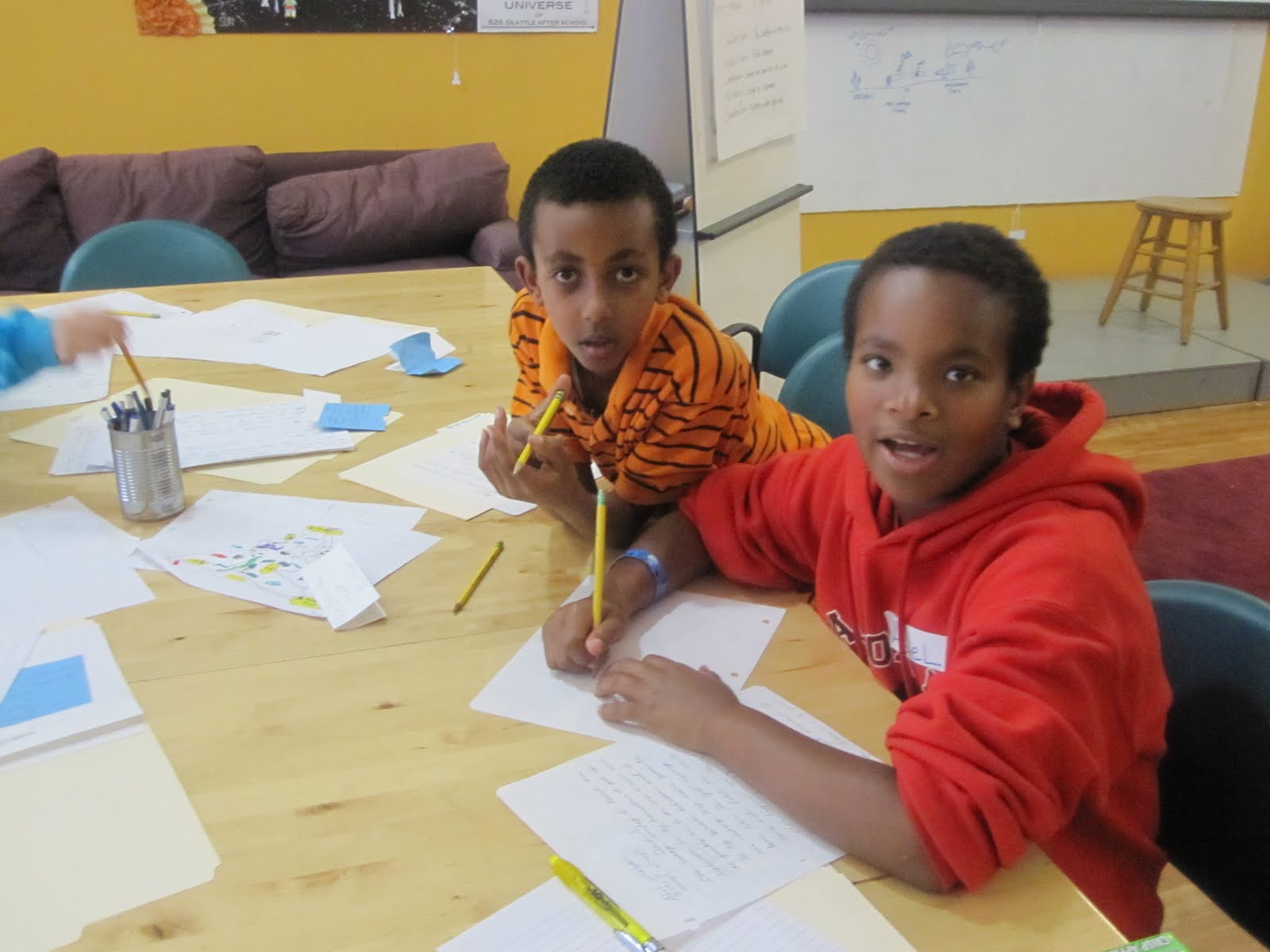
To get the participants thinking like pirates, Sue Elliott, Seattle Opera’s Director of Education, asked everyone to name his or her pirate ship. From there, we brainstormed good pirate names, nautical crew members, ship figureheads, and unique superpowers. Once everyone had a ship, we set sail with pen and paper and started writing our pirate tales.
To create a seafaring atmosphere, we used the format of a travel journal for our sailors to record their adventures at sea. Seattle Opera and 826 staff supported the writers as they took their characters through scrapes with sea monsters, encounters with vampire crews, and vaults of buried treasure. Sue also led activities like pirate charades to get writers to practice using descriptive adjectives and showing instead of telling. At the end of each day, the participants had a chance to read their work for everyone, and we all enjoyed hearing the stories fresh off the page.
On the last day, the writers worked on peer editing and revising their stories in preparation for their publication in a final chapbook. Once the stories were fine-tuned to their writers’ satisfaction, we quickly copied them while the writers warmed up for a final reading.

At the end of the day, everyone walked away with a story, a treasure map, and the music for Gilbert and Sullivan’s Pirate King stuck in their heads. The final chapbook will be available soon, recording all the fun these writers had in their wild week of adventure at sea.
Missed this one? Check Seattle Opera’s Education site for information on our upcoming programming for students, including workshops, camps, and activities.
Blog Post by Laura Marris, Education Intern
Photos by Jamal Hussein
Saturday, August 6, 2011
Donita Volkwijn To Sing BESS at Tonight's Performance (Sat. 8/6)

Donita Volkwijn first performed Bess with Tulsa Opera, and has played the role in a touring production in several major European cities. She has sung Micaela in Carmen for Hawaii Opera Theater, Syracuse Opera, and Tulsa Opera, where she also also performed both Mimì and Musetta in La bohème. Ms. Volkwijn has also sung Anna in Puccini's infrequently performed Le villi. Last season, she competed in the Mezzo Competition where she was selected to sing the part of the Condemned Female in David Alagna's Le dernier jour d'un condamne, which was performed in Debrecen and Szeged, Hungary.
Previous west coast credits for Ms. Volkwijn include Susanna in Le nozze di Figaro with the Bellingham Music Festival, Sister Rose in Dead Man Walking with Opera Pacific, and a number of credits with San Francisco Opera, where she was an Adler Fellow in 1999 and 2000. As a finalist in the 2005, 2001 and 2000 MacAllister Awards Competition, Ms. Volkwijn received the Glynn Ross Award.
A native of Cape Town, South Africa, Donita Volkwijn earned her Bachelor of Music degree in vocal performance from Oberlin College-Conservatory and her Master of Music degree from the Cleveland Institute of Music. In 1999 she made her European debut in Amsterdam with concert performances at the International Opera Center of the Netherlands.
Friday, August 5, 2011
Meet Our Singers: Lisa Daltirus, Bess
 Lisa Daltirus, our terrific Bess, returns to Seattle Opera--where she's most recently starred as Leonora in Il trovatore, and also as Aida and Tosca--in one of her favorite roles. She talks about playing both Bess and Serena in this opera, about touring with the South African production, and what she loves about Seattle.
How many times have you sung the role of Bess? What excites you about singing this opera?
I have had the fortune to alternate between Bess and Serena in about 10 productions. I love the extreme differences in these characters and enjoy exploring both. Bess has more development and dimensions to explore, which make it fun to sing and perform. I always look for layers in my characters and nuances of emotion and interaction. I strive to take the audience on a character's journey and show the struggle and heart of Bess. Of course, I love wearing the red dress!!

Lisa Daltirus (Bess) and Michael Redding (Crown) in Seattle Opera's current production of Porgy and Bess.
Photo by Elise Bakketun
Photo by Elise Bakketun
Audiences here enjoyed your performance as the fearsome Tosca, and now you’re playing a much gentler (though equally loving) character, Bess. Which of these characters has more in common with you as a person?
That's an interesting question as both roles rank among my favorites and I identify with both characters. For me they have similarities in personality. Both are perceived as tough on the outside in the initial introduction. However, we are quickly shown their Achilles heel, their desperation for survival, their drive to fix their situation by any means necessary. I certainly identify with thinking on your feet to solve a challenging problem and being influenced in certain decisions by love. I believe most of us have both fearsome and gentle characteristics in our make up.

Lisa Daltirus (Tosca) and Greer Grimsley (Scarpia) in Seattle Opera's 2008 production of Tosca.
Photo by Rozarii Lynch
Photo by Rozarii Lynch
Can you speak about how this opera plays in South Africa, versus how it’s received here in the United States? Have you noticed a different attitude toward Porgy and Bess abroad?
I performed a new production of Porgy and Bess with the Capetown Opera in South Africa that toured the UK ...Wales, London and Scotland. The production did not debut on the Capetown stage. But the concept set the drama in Soweto, in the time of apartheid. There were some specific changes and additions to the scenes and spontaneous dialogue that were specific to that culture and time in history. So in fact I don't know first-hand how the traditional Porgy and Bess plays to the audience in Capetown. I was told that the company has staged it for their home audience and it had lukewarm reviews because they didn't really identify with American southern culture of the 1930's. However, when we performed the new concept in the UK it was an overwhelming success. I also understand that the Barkhymer production that tours Europe regularly is very enthusiastically received.

Lisa Daltirus as Aida in Seattle Opera's 2008 production.
Photo by Bill Mohn
Photo by Bill Mohn
You’ve starred in several Seattle Opera productions now, and must know the city a bit. Do you have any fun area activities planned for your summer?
I absolutely LOVE coming to Seattle and consider it an operatic home. I have also had the good fortune to bring my children for vacation while I have been performing. The city has many fun things to do and we love the distinctive sections and neighborhoods. I love the Seattle Center activities, the Space Needle, and the lakes. I have not enjoyed an Argosy tour yet, and, strangely, have not yet visited Pike Place Market. I plan to change that situation! Otherwise, I will just enjoy revisiting the neighborhoods. I will also savor the low humidity.
Do you have a favorite performance of a song from Porgy and Bess by a non-opera performer?
It is wonderful to have so many renditions available to enjoy by a diverse group of performers. However, due to growing up in a household that had a heavy jazz influence, I love Ella Fitzgerald's "Summertime" and the instrumental arrangements of Miles Davis.
Thursday, August 4, 2011
Summer fun with "Pirates of Penzance"!
 This summer, the Greenlake Bathhouse is booming with fresh action, energy, and passion. Fifteen young students and campers are plunging into a brave, new, theatrical land: Gilbert and Sullivan. The bizarre, hilarious humor loosens up the kids and the catchy music leaves them singing the tunes all day long! As a voice student at DePaul University who recently performed in Gilbert and Sullivan’s The Mikado, I can speak from experience that singing in a G & S production is some of the most stimulating fun you can have on stage!
 Gilbert and Sullivan are best-known for shows such as H.M.S. Pinafore, The Mikado, The Gondoliers, Ruddigore (recently performed at the Rep’s Bagley Wright theater by Seattle Gilbert and Sullivan), and others. But Seattle Opera and Seattle Public Theatre’s summer opera camp chose The Pirates of Penzance, a story of pirates, deceit, police, love, generals, power, and doughy daughters. The Pirates of Penzance is the perfect opera for young, excited performers in the making.
On the first day, Director Kelly Kitchens began with some “get to know you” exercises focusing all our energy into acting. One of her magical gifts is her ability to treat every cast member like a seasoned theater professional, regardless of age or experience, while still keeping a fun, focused environment. I find myself learning loads from her, too! The kids absolutely love her; many join us in camp after camp throughout the year.
Later that day, our Musical Director Barbara Jamison helped the kids find their voices through lip trilling, stratospheric “Oh’s” and “Ah’s,” and recitative exercises. She puts all the campers on an equal footing and expects a good effort from everyone, recognizing right away each person’s strengths and talents. She brings great musical knowledge, and knows the repertoire and how to bring out the humor.
The beauty of The Pirates of Penzance is the huge chorus and number of roles. Both directors do a great job of keeping everyone involved at all times, with a handful of solo moments. However, everyone is learning every note.
Staging is underway, and as the cast dive into the sea of Penzance, the stage and music directors constantly remind them that they are in a “safe zone,” which is Kelly’s way of saying that the stage is a safe place to try new things in the rehearsal process, and taking risks is the foundation of their growth as performers.
This is the 4th collaboration between the Seattle Opera and Seattle Public Theatre, and with the trust building and music flowing, the kids are having a blast. You can attend the performance on Friday August 12 at 7 p.m., Saturday the 13th at 2 p.m. or 7 p.m., and Sunday the 14th at 2 p.m. at the Greenlake Bathhouse. Admission is free. Please check back for another update soon!
By Alexa Jarvis, Education Intern
Monday, August 1, 2011
Meet Our Singers: Michael Redding, Crown
 Now it's time to check in with the brutish villain of Porgy and Bess, Crown, played by the young American baritone Michael Redding. Michael--who, in real life, is neither brutish nor villainous--tells us about finding the humanity in the bad guy, what he has learned from Meryl Streep and Nina Simone, and which song from Porgy and Bess he'd most want to perform.
 You’re new to Seattle Opera...welcome! Can you tell us a little about your background? We’d love to know where you’re from, how you became involved in opera, and some of your favorite roles.
I come originally from the Atlanta area in Georgia, but I reside in Chicago. During audition season, while doing grad work at Indiana University, I would travel to Chicago and simply fell in love with the city. We freelance singers always need a major airport to get from one engagement to the next, so I chose Chicago! In regards to becoming involved with opera, I think it just kind of fell in my lap. People tried to steer me in the direction of musical theater, but I originally thought I was destined to be a professional choral singer (whatever that meant) because that’s what I grew up thinking, ie: Robert Shaw Chorale, etc. However, my first voice teacher quickly set me straight by helping me to uncover my voice and my love for the art form. I love all types of theater, but learning operatic roles and being on those particular stages is home for me. And I think it’s safe to say that every role is my favorite! It’s not so much what the role is, as much as it is what part of Michael Redding is in that role. So Crown and Marcello, to me, are one and the same!

Michael Redding as Crown in Seattle Opera's production of Porgy and Bess.
Photo by Elise Bakketun
Photo by Elise Bakketun
What was your first experience with Porgy and Bess?
My very first experience with Porgy and Bess was in high school where I performed “I Got Plenty o' Nuttin'” for a competition which essentially landed me in Governor’s School in Georgia for the summer! Admittedly, I had no idea about the piece, and would have sooner sung “My Man’s Gone Now” if I could have. I remember swooning and ‘ah-ing’ as I listened to that soprano just wail dramatically on the CD. That alone should have been an indication of my operatic destiny! [Laughs]
Crown isn’t necessarily the easiest character to like. What are some of his good qualities?
That’s a very interesting question--mainly because the more I get into performing this role, the more I realize that if as an audience member you never see the ‘other’ side to the villain, you won’t really have much connection to the character, and more than likely won’t believe the performance. I always think back to Meryl Streep’s comments about learning roles: she says that she goes for the reason why a character (especially the seemingly bad ones) acts the way they do. Crown is a bully, sure, but he takes care of Bess the only way he knows how. He loves to fight, for sport, but he’s not a full blooded killer, per se. And lest we forget that during the hurricane, out of all the men asked to go out and save Clara and Jake, Crown is the only one who volunteers. He’s human and humans have flaws, so “good qualities” is somewhat relative, in my opinion.

Michael Redding (Crown) and Lisa Daltirus (Bess) in Seattle Opera's production of Porgy and Bess.
Photo by Elise Bakketun
Photo by Elise Bakketun
You recently sang Porgy in Atlanta. What is it like singing that role, versus Crown?
Oh gosh...I think if you ask anyone who has performed both these roles (and the progression of singing Crown early on and then singing Porgy later is common), they would say they’d rather sing Porgy any day. Especially the older we get. I think both roles are equally demanding physically--one is either on a crutch or his knees all night, and the other is constantly doing something brutal at a high level of energy--so that's not the difference. However, I would sooner perform Porgy. It’s a much longer sing, but it’s tailor made for the voice. And performing the role of Porgy just always seems to put me in a beautiful place spiritually and emotionally. Simply said, everybody loves Porgy!

Michael Redding's Crown scandalizes the inhabitants of Catfish Row with his arrogance in the face of the hurricane in Seattle Opera's production of Porgy and Bess.
Photo by Elise Bakketun
Photo by Elise Bakketun
It seems that nearly everyone is familiar with the music of Porgy and Bess, thanks to countless renditions over the years. Do you have a favorite performance of a song from Porgy and Bess by a non-opera performer?
Nina Simone, by far! Her rendition of “I loves you, Porgy” is incredibly heart-wrenching. It gives the piece an entirely different outlook, which I think Gershwin would have loved!
Subscribe to:
Comments (Atom)
Also Find Us Here


Subscribe To


 Posts
All Comments
Posts
All Comments